
Summary of the Article
TCF stands for Test de Connaissance du Français, which means "French knowledge test." It is an official French proficiency test for non-native speakers, run by France Éducation International (FEI) since 2002. Your result is a CEFR level from "A1 not achieved" up to C2, and the certificate is valid for two years.
- TCF Tout Public: the general version for study, work, or personal goals; three multiple-choice sections plus optional writing and speaking.
- TCF Canada: the version accepted by IRCC for Canadian economic immigration and citizenship; all four skills, 2h47 total.
- TCF Québec: for Québec immigration applications through the MIFI.
- TCF IRN: for French residence permits and nationality; expanded to B2 in May 2025.
If your goal is Canadian permanent residence, TCF Canada is the one you need. Everything else in this article explains the test behind that one decision.
What Does TCF Mean?
TCF is short for Test de Connaissance du Français. Translated word by word, it is a "test of knowledge of French." In practice, it measures how well you actually use French, not how much grammar theory you have memorized.
If you searched for the "TCF full form" or what "TCF means," this is the answer: it is France's official standardized French test for people whose first language is not French. Think of it as the French cousin of TOEFL or IELTS. In fact, the FEI history of the TCF says it was created in the spirit of those two English tests.
One important thing the TCF is not: it is not a course exam. There is no official syllabus to study. It measures general French ability, which shapes how you should prepare (more on that later).
Who Runs the TCF, and Since When?
France Éducation International (FEI), the French government agency formerly known as CIEP, launched the TCF in 2002. It has since grown into one of the main French proficiency tests worldwide.
The different versions arrived as different governments needed them:
- 2002: TCF Québec, built at the request of Québec authorities.
- 2012: TCF ANF (Access to French Nationality), for French citizenship applicants.
- 2018: TCF CRF (Resident Card in France), requested by the French Interior Ministry.
- 2019: Canada accepted the TCF Canada for immigration; it has been valid for IRCC economic immigration and citizenship applications since January 1, 2019.
- 2022: TCF ANF and TCF CRF merged into a single test, TCF IRN.
Who Can Take the TCF?
Anyone aged 16 or older whose first language is not French can register. You do not need any diploma, any prior French course, or any minimum level. Beginners and advanced speakers take the same test, because the questions get harder as you go and the scoring places you at your level.
People take it for three broad reasons: academic (for example, admission to French universities), professional (employers or professional bodies), and personal or administrative (immigration, residence, citizenship).
The Four TCF Variants
"The TCF" is really a family of four tests. They share the same scoring logic and the same two-year validity, but each serves a different authority and a different goal:
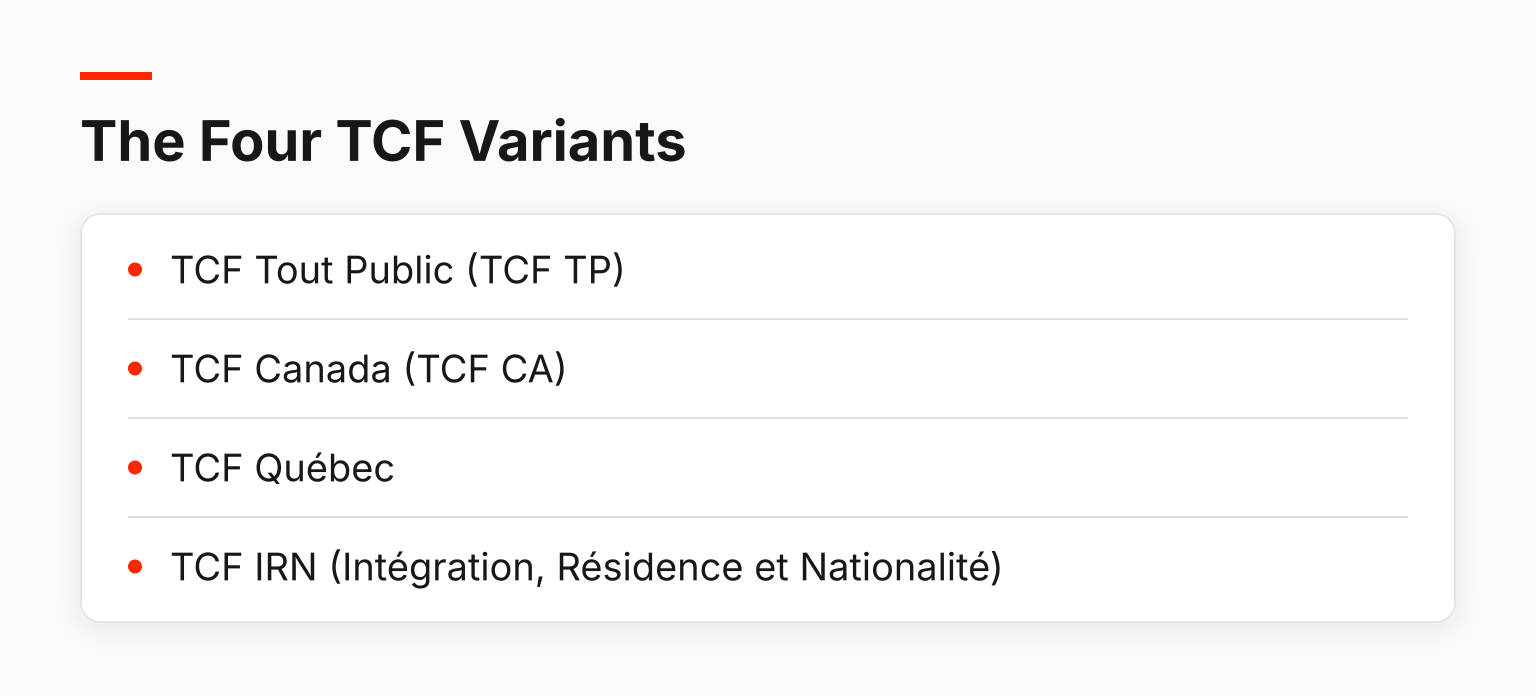
- TCF Tout Public (TCF TP): the general-purpose version for study, work, or personal reasons.
- TCF Canada (TCF CA): for economic immigration to Canada or Canadian citizenship, filed with IRCC. If you are applying for Canadian permanent residence through Express Entry, this is the variant IRCC will ask for.
- TCF Québec: for immigration to the province of Québec, filed with the MIFI (Québec's immigration ministry).
- TCF IRN (Intégration, Résidence et Nationalité): for French residence permits and French nationality.
The versions differ in structure too. TCF Tout Public has three compulsory multiple-choice sections and lets you add optional writing and speaking. TCF Canada and TCF Québec are built around all four skills, because immigration authorities score each skill separately.
One recent change worth knowing: as of May 12, 2025, the TCF IRN assesses up to level B2 instead of stopping at B1, and its total duration grew from 1h15 to 1h35. The official figures come from the April 2025 FEI candidate manual. French language requirements also changed from January 1, 2026, so check the French Interior Ministry's current requirements for your permit type before you book. Older third-party guides that still describe the IRN as a 1h15, B1-maximum test are out of date.
What the TCF Looks Like on Test Day
TCF Tout Public
Three compulsory multiple-choice sections, 1h25 in total, plus two optional expression sections:
| Section | Format | Duration |
|---|---|---|
| Listening comprehension | 29 multiple-choice questions | 25 minutes |
| Language structures (grammar and vocabulary) | 18 multiple-choice questions | 15 minutes |
| Reading comprehension | 29 multiple-choice questions | 45 minutes |
| Written expression (optional) | 3 writing tasks | 60 minutes |
| Oral expression (optional) | 3 speaking tasks, one-on-one with an examiner | 12 minutes |
TCF Canada
Four compulsory sections, 2 hours 47 in total:
| Section | Format | Duration | Score scale |
|---|---|---|---|
| Listening comprehension | 39 multiple-choice questions | 35 minutes | 0 to 699 |
| Reading comprehension | 39 multiple-choice questions | 60 minutes | 0 to 699 |
| Written expression | 3 writing tasks | 60 minutes | 0 to 20 |
| Oral expression | 3 speaking tasks with an examiner | about 12 minutes | 0 to 20 |
These figures match the FEI candidate manual (2026 version Q) and the Alliance Française Toronto TCF Canada page. The listening and reading sections play recordings or show texts once, with four answer choices each. The writing tasks have minimum word counts (60, 120, and 120 words for tasks 1, 2, and 3). The speaking tasks go from a short interview to giving and defending an opinion.
How TCF Scoring Works
You never get a simple pass or fail. Each skill gets its own score, and that score converts to a level on the CEFR scale, the Common European Framework of Reference for Languages:
- A1 not achieved: below A1.
- A1 to B1: beginner to intermediate. You can handle everyday situations.
- B2: upper intermediate. You can argue a point and understand complex text. This is the level Canadian immigration cares about.
- C1 to C2: advanced to near-native.
For the multiple-choice sections, your score is a number from 0 to 699. The calculation weighs question difficulty rather than a raw count of correct answers, so it is not something you can average yourself. Expression sections on TCF Canada are scored out of 20.
What the Levels Mean for Canadian Immigration
Canadian authorities use a different scale for French: the NCLC (Niveaux de compétence linguistique canadiens). IRCC converts your TCF Canada scores into an NCLC level for each skill.
The milestone most Express Entry candidates aim for is NCLC 7 in all four skills, because that is where the major French-language CRS bonus kicks in. On TCF Canada, NCLC 7 means:
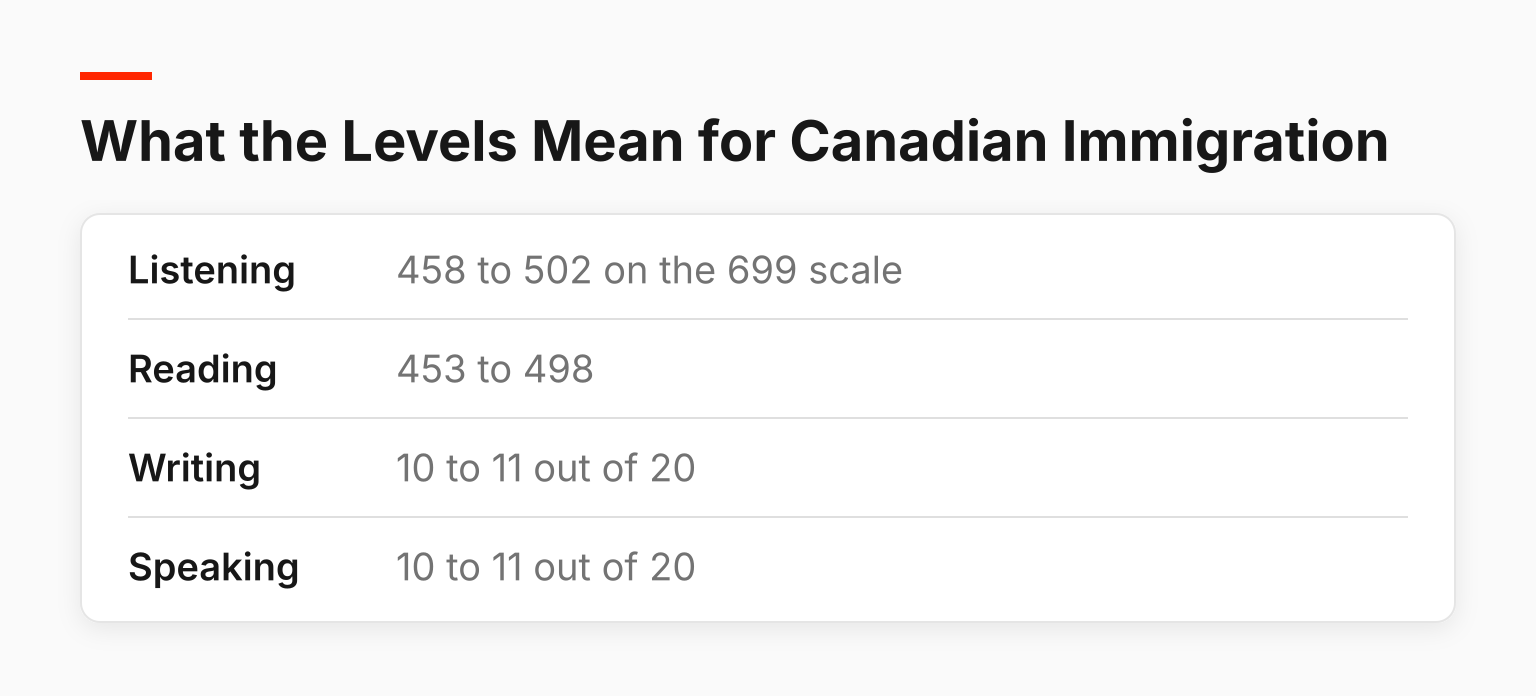
- Listening: 458 to 502 on the 699 scale
- Reading: 453 to 498
- Writing: 10 to 11 out of 20
- Speaking: 10 to 11 out of 20
The official IRCC language test table lists every band from NCLC 4 to NCLC 10+. For the full CEFR to NCLC mapping and what NCLC 7 means for your score, see the site's TEF & TCF Canada to NCLC conversion guide.
Keep your certificate's expiry in mind too: results are valid for two years, and IRCC requires them to still be valid when you submit your application.
TCF vs TEF: What's the Difference?
You will constantly see the TCF mentioned next to the TEF (Test d'évaluation du français). Both are official French tests, both are accepted by IRCC for Canadian immigration, and both map scores to the CEFR scale. The TEF is run by the Paris Île-de-France Chamber of Commerce, while FEI runs the TCF, and the exact sections and question counts differ.
For Canadian readers, the practical answer is usually "either one works; pick the format that suits you." If you are weighing them, the site's TEF Canada vs TCF Canada comparison goes through the differences section by section, and there is also an honest which-is-easier comparison if difficulty is your main question.
Which TCF Do You Need?
Match your goal to the version:
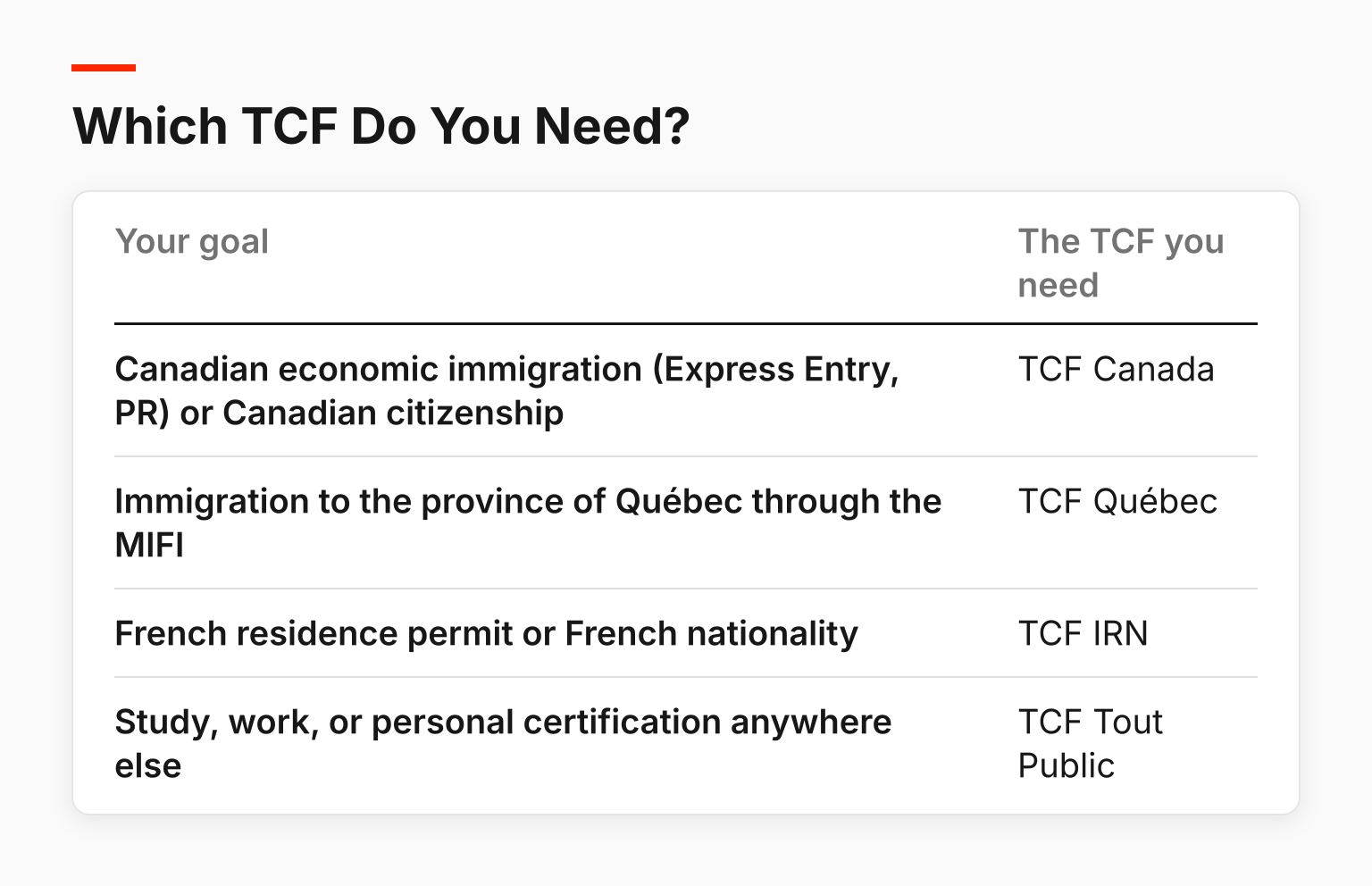
| Your goal | The TCF you need |
|---|---|
| Canadian economic immigration (Express Entry, PR) or Canadian citizenship | TCF Canada |
| Immigration to the province of Québec through the MIFI | TCF Québec |
| French residence permit or French nationality | TCF IRN |
| Study, work, or personal certification anywhere else | TCF Tout Public |
Two practical notes for Canadian readers. First, TCF Canada is only offered in person at approved exam centers, not online. Second, if your path runs through the MIFI, check its current list of accepted tests, because Québec follows its own scoring and admissions process.
For the full picture of the Canadian version, including registration and score details, the site's TCF Canada Guide (2026) covers everything a PR applicant needs.
How to Prepare for the TCF
Because the TCF tests general skill rather than a syllabus, memorizing word lists alone will not move your level. What works:
- Learn your variant's exact format. Knowing that TCF Canada listening is 39 questions in 35 minutes changes how you practice.
- Practice with past-style questions. Mock exams teach you the pacing and the traps (especially questions that get progressively harder).
- Immerse daily. French radio, podcasts, and short videos build the listening speed that 35-minute sections demand.
- Drill your weakest skill. Most candidates are uneven across the four skills, and immigration scoring needs all four above the bar.
If you now know you need TCF Canada, a good first step is a realistic TCF Canada practice test with a 4-skill prep plan. From there, structured practice across listening, reading, writing, and speaking with NCLC tracking tells you exactly how far you are from 7 in each skill.
Common Questions About the TCF
How much does the TCF cost? There is no fixed national price. Each approved center sets its own fee. For example, Alliance Française Toronto charges CAD $390 for the full TCF Canada, while other centers charge different amounts, so check your local center's exam page for current pricing.
Can I take it on a computer? Yes. The TCF is available in paper and computer formats at approved centers, and the speaking part is always face to face with an examiner. Computer-based results usually arrive faster.
How soon do I get results? Timing varies by center and format, but most candidates receive their results a few weeks after the session. Ask your center what to expect, and plan your application timeline around it.
Can I retake it? Yes, as many times as you want, but a waiting period of at least 20 days must separate two sessions. Plan study time between attempts rather than just rebooking.
Your Next Step
If you are reading this because of a Canadian immigration goal, the decision is simple: you need the TCF Canada, four skills at NCLC 7 or higher, and a certificate that stays valid through your application. Sign up to start free practice with 1,000 credits and find out exactly where you stand in each skill.