
Summary of the Article
Neither test is easier overall. Each one is harder in a different place, so the right answer depends on your strengths.
- Listening: TEF gives you 40 questions in 40 minutes; TCF gives you 39 in 35 minutes. TCF is a bit faster-paced.
- Speaking: TEF is 2 sections with one long persuasion task (about 10 minutes). TCF is 3 shorter tasks (12 minutes total), with 2 minutes of prep on the middle task.
- Writing: TEF is 2 longer pieces (80+ and 200+ words). TCF is 3 shorter pieces with different goals, so you switch tasks more.
- Cost: Around CAD $390 at many test centres (TCF has run about $400 in some cities). Fees are set per centre, so confirm locally.
- Retakes: Same rules for both: a 20-day wait between attempts, no attempt cap, and 2-year validity.
If you argue well for long stretches, TEF may feel easier. If you do better in short, structured bursts, TCF may fit you. The details below show why.
What's the Same Before We Compare
Start with the basics, because they narrow the question. Both tests are accepted by Immigration, Refugees and Citizenship Canada (IRCC) for Express Entry and PR. Both test the same four skills: listening, reading, writing, and speaking. Both require you to hit NCLC 7 or higher in each skill, and both results are valid for 2 years. Both exams also require all four components in a single day for immigration purposes.
That matters for the "easier" question. Since the goal is identical, the only real difference is which format of difficulty you prefer. If you want the immigration-fit angle rather than difficulty, read our TEF Canada vs TCF Canada: Which Test for Immigration? comparison.
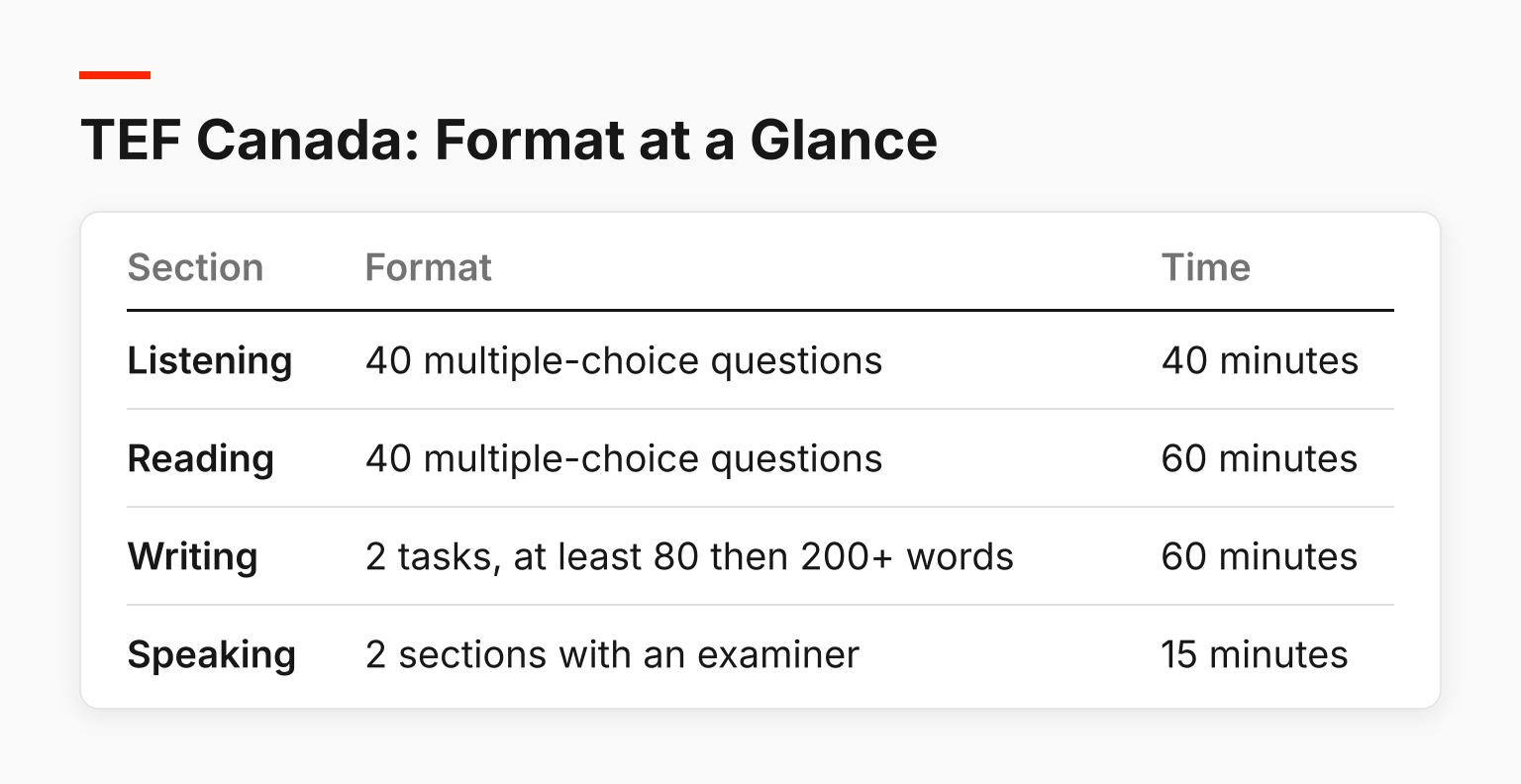
TEF Canada: Format at a Glance
TEF Canada is run by CCI Paris Île-de-France and is IRCC-recognized for Express Entry and PR.

| Section | Format | Time |
|---|---|---|
| Listening | 40 multiple-choice questions | 40 minutes |
| Reading | 40 multiple-choice questions | 60 minutes |
| Writing | 2 tasks, at least 80 then 200+ words | 60 minutes |
| Speaking | 2 sections with an examiner | 15 minutes |
The listening and reading sections use multiple-choice questions where wrong answers can cost you points, so guessing blind is risky. Writing asks for two pieces of growing length, and speaking is a face-to-face interview in two parts.
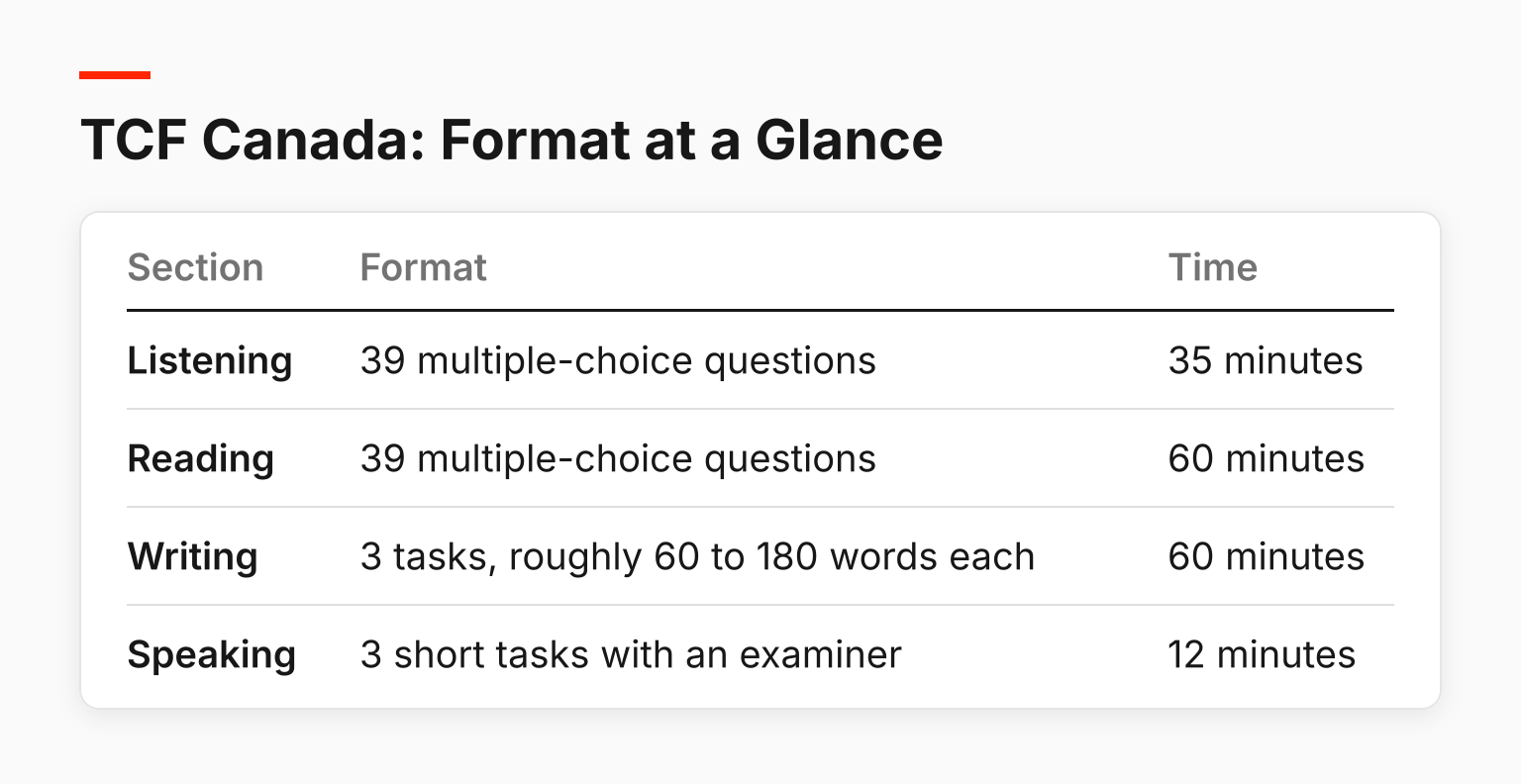
TCF Canada: Format at a Glance
TCF Canada is run by France Éducation international and is also IRCC-recognized for Express Entry and PR.

| Section | Format | Time |
|---|---|---|
| Listening | 39 multiple-choice questions | 35 minutes |
| Reading | 39 multiple-choice questions | 60 minutes |
| Writing | 3 tasks, roughly 60 to 180 words each | 60 minutes |
| Speaking | 3 short tasks with an examiner | 12 minutes |
The structure looks similar on paper, and both comprehension sections get about the same time per question. The difficulty shows up in where each test concentrates its pressure, which is what the next sections cover.
Listening: More Time on TEF
TEF listening gives you 40 questions in 40 minutes. TCF gives you 39 questions in 35 minutes. That is close to the same workload in five fewer minutes on TCF.
In practice, the difference is pacing pressure. On TCF, you get slightly less time per question, and both tests play each recording only once, so a lost second can cost an answer. Candidates who follow spoken French easily may not notice. Candidates who need a beat to process audio often find TCF's pace tighter.
If you want drills for this section, our guide to French numbers for TEF Canada listening covers dates, prices, and phone numbers, which trip people up on both exams.
Speaking: One Long Argument vs Three Short Tasks
This is where the two tests feel the most different.
TEF Canada speaking (15 minutes, 2 sections):
- Section A: a short role-play where you ask questions and get answers, about 5 minutes.
- Section B: a longer persuasion task, about 10 minutes, where you convince the examiner of a position.
Section B is the test's hardest stretch for many candidates. You have to hold an argument, react to pushback, and keep talking for roughly ten minutes. If you prepare with a framework, that length becomes an advantage: you have time to show structure. Our TEF Canada speaking cheat sheet shows the framework we used to reach NCLC 7.
TCF Canada speaking (12 minutes, 3 tasks):
- Task 1: a short interview about yourself, no prep time.
- Task 2: an interaction with the examiner. The official TCF candidate manual gives you 2 minutes of prep for this task only, and examiners may interrupt if they suspect a rehearsed speech.
- Task 3: an opinion question with no prep time.
Note that some prep sites claim TCF speaking has no preparation time at all. The official manual says 2 minutes for Task 2. Either way, TCF rewards candidates who can think on their feet in short bursts, and it never asks you to sustain one argument for ten minutes.
So: confident improvisers often prefer TCF. Candidates who like structure and time to build a case often prefer TEF. Neither is objectively easier; they punish different weaknesses.
Writing: Two Long Pieces vs Three Short Ones
TEF writing is two tasks in 60 minutes, with a minimum of about 80 words and then 200+ words. The second task is long, so endurance and paragraph organization matter.
TCF writing is three tasks in 60 minutes, roughly 60 to 120, 120 to 150, and 120 to 180 words. Each piece has a different goal (a message, an experience, a comparison-style piece), so you switch register and task type repeatedly. No single piece is very long, but there are three chances to slip.
If you write slowly but well once you get going, TEF's two-piece format suits you. If you can produce correct short texts quickly but run out of steam on long ones, TCF suits you.
Scoring: What NCLC 7 Actually Requires
The two tests report scores differently, and that changes how the target feels.
TEF Canada: each skill has its own scale. Listening runs to 360 points, reading to 300, and writing and speaking to 450 each. IRCC's language test conversion tables put NCLC 7 at 249 to 279 in listening, 207 to 232 in reading, and 310 to 348 in both writing and speaking. Newer TEF statements also show a harmonized score out of 699, but IRCC tells Express Entry candidates to use the older-score column on the certificate, not the /699 figure.
TCF Canada: listening and reading are scored out of 699, while writing and speaking are graded out of 20. The same IRCC tables put NCLC 7 at 458 to 502 in listening, 453 to 498 in reading, and 10 to 11 out of 20 in writing and speaking.
The practical takeaway: on TCF, writing and speaking are graded by an examiner against a rubric, so a 10/20 means your performance crosses a quality bar, not a points tally. Some candidates find the /20 scale easier to target because the descriptors are clear. Others find the comprehension sections easier because more questions spread the risk. Either way, check the current conversion table before you book, because IRCC reissues these charts.
For the full scoring and registration picture, see our TCF Canada Guide (2026): Format, Scores & Immigration.
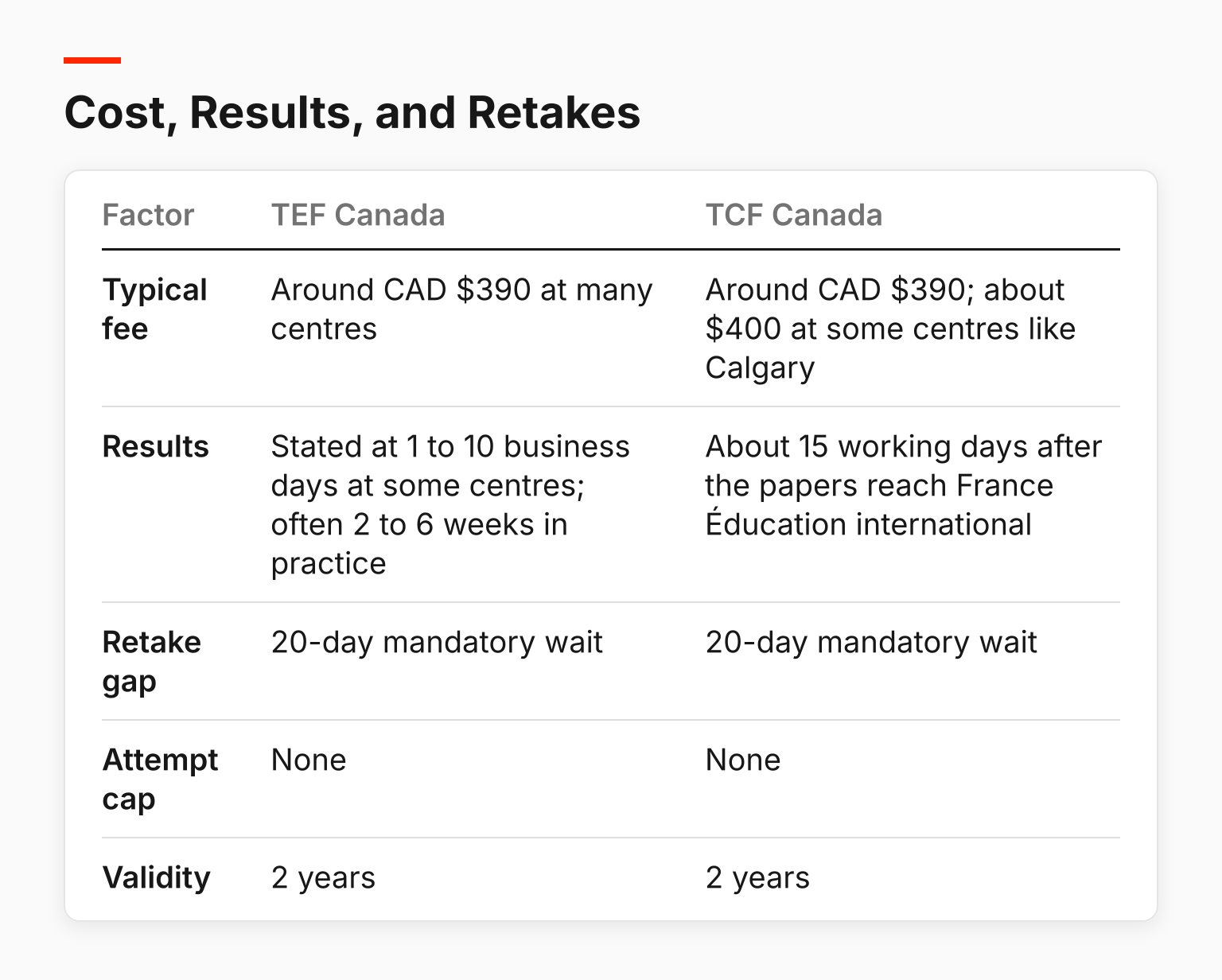
Cost, Results, and Retakes
| Factor | TEF Canada | TCF Canada |
|---|---|---|
| Typical fee | Around CAD $390 at many centres | Around CAD $390; about $400 at some centres like Calgary |
| Results | Stated at 1 to 10 business days at some centres; often 2 to 6 weeks in practice | About 15 working days after the papers reach France Éducation international |
| Retake gap | 20-day mandatory wait | 20-day mandatory wait |
| Attempt cap | None | None |
| Validity | 2 years | 2 years |
Fees are set by each test centre, so check your local centre for the current price. Result speed also varies by centre: some TEF centres report results in days, while candidates elsewhere wait weeks for both exams. Build your Express Entry timeline around the slower number, not the best case.
Once you have picked a test and a date, you can estimate your prep runway with our NCLC 7+ time estimator, then see what the result is worth in points with the CRS French bonus calculator.
Watch Out for Anecdotal "Easier" Claims
Search forums and social media and you will find confident answers. One Quora thread asks what is the difference between the TCF and the TEF exam, Reddit users argue one listening section is harder than the other, and prep sites compare the two exams with different verdicts.
These claims are usually true for the person making them, not for you. "TCF listening is harder" often means the speaker needed more processing time, which is exactly the pacing difference described above. Use anecdotes as hints about what might bother you, not as verdicts.
Which Test Should You Pick?
Match the exam to your profile:
- Pick TEF Canada if: you can sustain a long argument, you like structured frameworks you can extend, and you prefer slightly more time per listening question.
- Pick TCF Canada if: you improvise well without long prep, you prefer short tasks over one long performance, and you like clear rubric-based grading for writing and speaking.
- Pick whichever is available sooner if: you are genuinely balanced between the two. Since preparation transfers almost fully across the four skills, a sooner exam date can be worth more than a small format preference.
Because both tests measure the same four skills at the same NCLC 7 bar, most of your preparation, including vocabulary work, listening drills, and speaking frameworks, carries over. If you change your mind after starting, you lose little.
At CanadaFrenchPath, we prepare you for both exams across all four skills, with mock exams in each format, personalized study plans, live tutor support, AI grading, and NCLC tracking, so you can test which format fits before you book a date.
**Ready to try both formats? Start free practice with 1,000 credits and see which exam style suits you before you pay a registration fee.**
Frequently Asked Questions
Is NCLC 7 easy to reach on either test? It is achievable but not easy. NCLC 7 is roughly B2 level in every skill, and you need it in all four skills, not just some. Most candidates need months of targeted practice, not weeks.
Which is cheaper, TEF or TCF? At many centres the fee is about the same, around CAD $390. Some centres charge slightly more for one exam or the other. Fees are set per centre, so confirm with the centre where you plan to book.
Can I retake just one section? Both exams require all four components in one sitting for immigration validity. Retake rules can vary by centre, with some requiring a full re-sit, so ask your centre before booking a retake. There is a 20-day mandatory wait between attempts for both tests.
How fast do results come back? It varies. Some TEF centres state results within 1 to 10 business days, though 2 to 6 weeks is common in practice. TCF results take about 15 working days after the papers reach France Éducation international. Treat these as ranges and plan conservatively.