
Summary of the Article
TEF and TEF Canada share a name but are not interchangeable. If your goal is Express Entry or Canadian permanent residence, IRCC accepts only TEF Canada (or TCF Canada). A TEF Tout Public result cannot be substituted, no matter how high your score.
- TEF Canada: 4 compulsory sections (listening, reading, writing, speaking) on the same day; the only TEF version IRCC accepts for federal immigration.
- TEF Tout Public: up to 5 modular sections you choose by purpose; fine for studies, work or personal goals, but not valid for Express Entry or PR.
- Citizenship: a lighter TEF Canada sitting with only listening and speaking.
- Scoring: both print a "Score / 699" column, but IRCC only reads the "Équivalence ancien score" column for Express Entry.
Here is how the two versions differ, what NCLC 7 requires, and how to register for the right session the first time.
The bottom line: only TEF Canada counts for Express Entry and PR
IRCC lists exactly two approved French tests for Express Entry: TEF Canada and TCF Canada. IRCC's language test page states this directly and warns that entering the wrong scores can get your application refused.
The exam body's own TEF page puts it another way: every TEF version corresponds to a specific project, and your results are valid only for the use that version was designed for. TEF Tout Public was built for academic, professional, or personal purposes. It was not built for Canadian federal immigration.
So before you pay any registration fee, confirm the exact version on your confirmation email: it must say TEF Canada.
What TEF (Tout Public) is
The general TEF Tout Public is the original test, created in 1998 by the CCI Paris Île-de-France for academic, professional, and personal purposes. It is modular: depending on your goal, you take 1 to 5 sections chosen from:
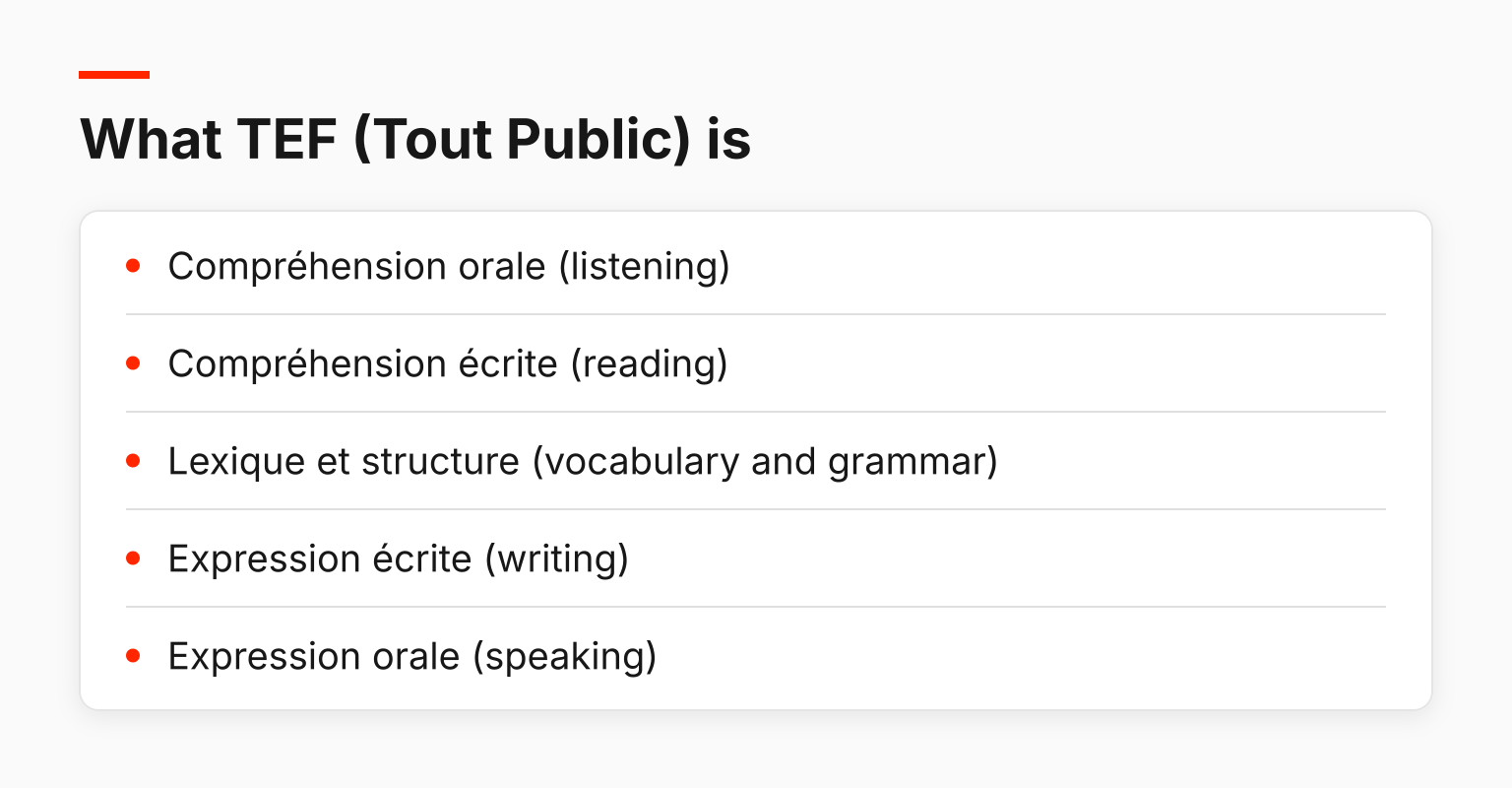
- Compréhension orale (listening)
- Compréhension écrite (reading)
- Lexique et structure (vocabulary and grammar)
- Expression écrite (writing)
- Expression orale (speaking)
People use it for French university admission, job applications, French residence or nationality files, and personal benchmarking. The candidate page from Le français des affaires explains that the version you take depends on your objective. That flexibility is exactly why it cannot serve immigration: the content you sit can change, and Canadian authorities need a fixed, same-day, four-skill result.
What TEF Canada is
TEF Canada is a fixed version designed for Canadian immigration and citizenship, recognized by IRCC since 2002. The exam body's official TEF Canada page sets out the structure:
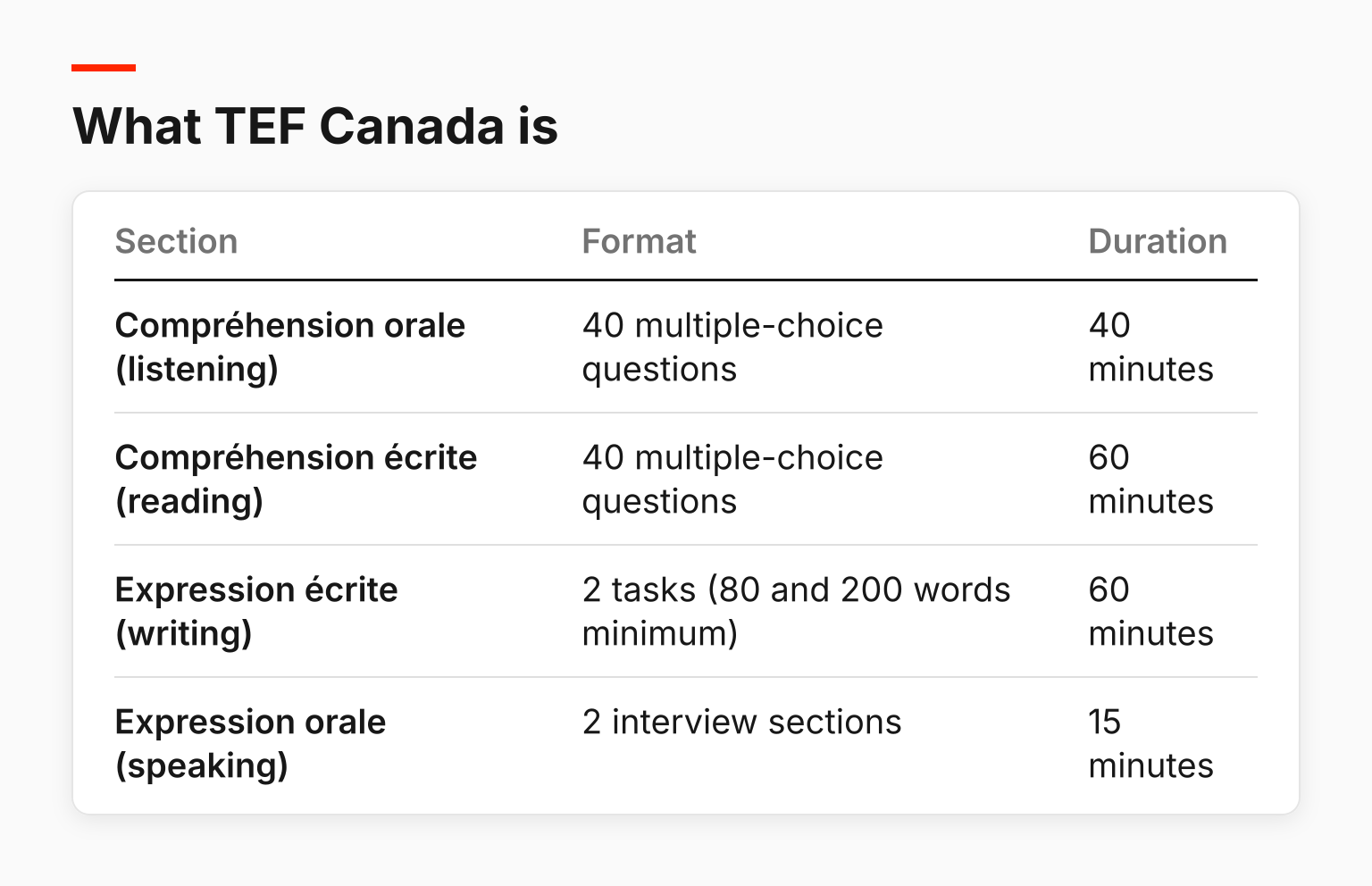

For immigration (4 compulsory sections, all the same day):
| Section | Format | Duration |
|---|---|---|
| Compréhension orale (listening) | 40 multiple-choice questions | 40 minutes |
| Compréhension écrite (reading) | 40 multiple-choice questions | 60 minutes |
| Expression écrite (writing) | 2 tasks (80 and 200 words minimum) | 60 minutes |
| Expression orale (speaking) | 2 interview sections | 15 minutes |
For Canadian citizenship (2 sections): listening and speaking only.
The exam body stresses one rule candidates miss: all sections must be sat the same day for the certificate to be recognized by Canadian authorities.
TEF Canada vs TEF Tout Public at a glance
| TEF Canada | TEF Tout Public | |
|---|---|---|
| Purpose | Canadian immigration and citizenship | Studies, work, personal, French residence or nationality |
| Sections | 4 compulsory (2 for citizenship) | 1 to 5 modular, includes Lexique et structure |
| Same-day rule | Yes, required | Sections can be scheduled as needed |
| IRCC acceptance for Express Entry/PR | Yes | No |
| Score column IRCC reads | "Équivalence ancien score" | Not applicable |
| Validity | 2 years | 2 years |
The scoring trap: Score / 699 vs Équivalence ancien score
Both versions report results out of 699. That number is where many candidates lose points without knowing it.
Your TEF Canada attestation shows two sets of numbers. IRCC's instructions are explicit: enter only the scores from the "Équivalence ancien score" column in your Express Entry profile. The "Score / 699" figures are not compatible with IRCC's system, and typing them in can lead to refusal.
What NCLC 7 requires on TEF Canada
Express Entry converts your TEF Canada scores into NCLC levels. To reach NCLC 7 in each ability, you need at least:
| Ability | Score range for NCLC 7 |
|---|---|
| Speaking (expression orale) | 310-348 |
| Listening (compréhension de l'oral) | 249-279 |
| Reading (compréhension de l'écrit) | 207-232 |
| Writing (expression écrite) | 310-348 |
These ranges come from IRCC's TEF Canada grid. For a full walkthrough of every level, see the site's guide to TEF & TCF Canada to NCLC conversion.
NCLC 7 in all four abilities matters for two reasons:
- It is the French requirement for the Federal Skilled Worker Program as a first official language, and the level required for Express Entry's French-language category draws.
- It unlocks an additional CRS bonus: 25 points if your English is CLB 4 or lower (or untested), or 50 points if your English is CLB 5 or higher in all four skills. IRCC's CRS criteria page lists both tiers.
IRCC does not average the four abilities. One section at NCLC 6 and the rest at NCLC 8 does not qualify. If you want to estimate what this is worth to your profile, the site's free CRS calculator shows the French bonus inside a full score estimate.
Other TEF versions not to confuse
The TEF family has more than two members, and booking the wrong one is a common and expensive mistake:
- TEFAQ (TEF Québec): used for Québec immigration. IRCC does not recognize it for federal Express Entry files.
- TEF Études: for admission to francophone higher education, including the French DAP procedure since 2004.
- TEF IRN: a shorter version for French residence and nationality purposes, with reduced durations and question counts.
If your goal is Canadian federal PR, the name on your registration must be TEF Canada. If your goal is a Québec selection certificate, that is a different process, and TEFAQ may fit instead.
How to register for the right session
Work through this checklist before you pay:
- Confirm the version. Ask the centre for TEF Canada specifically, and get it in writing on your confirmation.
- Book at an official CCI-accredited test centre. Only these centres administer TEF Canada.
- Check fees with the centre. Exam bodies do not set a single price; each centre sets its own fees.
- Plan the timing. You must wait 20 days between sittings, so leave room for a retake before your results expire.
- Match your ID. The name on your registration must match the identity document you will use in your immigration application.
- Remember the 2-year rule. IRCC requires results to be less than 2 years old when you submit your Express Entry profile and your PR application; expired results mean a refused application.
- Sit all four sections the same day. A split sitting does not produce a certificate Canadian authorities accept.
If you already took the wrong version
A TEF Tout Public result cannot be converted or upgraded into an immigration certificate. The fix is straightforward: register for TEF Canada at an approved centre and sit all four compulsory sections in one session. Keep the 20-day wait and the 2-year validity window in mind when you pick a date.
If you took TEF Canada but entered Score / 699 values in your Express Entry profile, correct the fields with the Équivalence ancien score column before you submit an application.
Your next step after choosing TEF Canada
Once the right version is booked, the work is reaching NCLC 7 in all four skills. If you are stuck between B1 and NCLC 7, the guide on why most TEF Canada candidates plateau covers what typically holds people back. And if you are still deciding between the two approved French exams, start with the site's comparison of TEF Canada vs TCF Canada.
When you are ready to practice, sign up on CanadaFrenchPath to start free practice with 1,000 credits: four-skill drills, mock exams, and NCLC tracking built around the scores in this article.