
Summary of the Article
NCLC 7 is not one score. IRCC grades each of the four skills separately, and the number you enter depends on which test you took and which score column is on your certificate. Use IRCC's official conversion tables below and check every skill before you submit.
- TEF Canada, “Équivalence ancien score” column (the one IRCC says to use for Express Entry): Speaking 310–348, Listening 249–279, Reading 207–232, Writing 310–348.
- TEF Canada, “Score / 699” column: Reading 434–461, Writing 428–471, Listening 434–461, Speaking 456–493. IRCC says do not enter these in your Express Entry profile.
- TCF Canada: Speaking 10–11, Listening 458–502, Reading 453–498, Writing 10–11.
- One skill below NCLC 7 means you do not meet the threshold, even if the other three are excellent.
Reaching NCLC 7 in all four skills unlocks the Federal Skilled Worker Program floor, eligibility for French-language category draws, and up to 50 extra CRS points. Below are the full TEF Canada to NCLC conversion tables, plus the TCF Canada equivalents, straight from IRCC.
What NCLC 7 means in TEF Canada
NCLC stands for Niveaux de compétence linguistique canadiens. It is the French-language scale IRCC uses, the same idea as CLB for English. NCLC 7 roughly matches B2-level French, so you can follow everyday spoken French, read typical articles, and write clear paragraphs on familiar topics.
For TEF Canada, the NCLC 7 thresholds differ by skill. Reading 7 requires less than Speaking 7, for example, because the skills are scored on different scales.
TEF Canada: official NCLC conversion table
IRCC publishes two TEF Canada tables, and mixing them up is the single most common mistake candidates make. IRCC's Express Entry language test page is the authoritative source for both.
TEF Canada for Express Entry: use the “Équivalence ancien score” column
For Express Entry, IRCC says your level is based on the “Équivalence ancien score” (previous score equivalency) column of your TEF certificate. Its exact words: enter only the scores from that column, because the “Score / 699” column “isn't compatible with our system at this time,” and entering the wrong scores can get your application refused.
| NCLC | Speaking | Listening | Reading | Writing |
|---|---|---|---|---|
| 9 and above | 371+ | 298+ | 248+ | 371+ |
| 8 | 349–370 | 280–297 | 233–247 | 349–370 |
| 7 | 310–348 | 249–279 | 207–232 | 310–348 |
| 6 | 271–309 | 217–248 | 181–206 | 271–309 |
| 5 | 226–270 | 181–216 | 151–180 | 226–270 |
| 4 | 181–225 | 145–180 | 121–150 | 181–225 |
So for the question “what score is CLB 7 in TEF?” for Express Entry: Speaking 310–348, Listening 249–279, Reading 207–232, Writing 310–348. This is the TEF Canada CLB 7 score most readers actually need, because IRCC applies the ancien score grid whatever the date of your test.
TEF Canada “Score / 699” column (tests after December 10, 2023)
Newer TEF certificates also show a raw score out of 699 for each skill. IRCC publishes a conversion table for that scale too (shown on its post-graduation work permit language results page):
| NCLC | Reading | Writing | Listening | Speaking |
|---|---|---|---|---|
| 8 | 462–502 | 472–511 | 462–502 | 494–517 |
| 7 | 434–461 | 428–471 | 434–461 | 456–493 |
| 6 | 393–433 | 379–427 | 393–433 | 422–455 |
Useful for checking your level on the new scale, but for an Express Entry profile, IRCC still tells you to enter the ancien score column. The /699 numbers are not accepted in the profile system right now.
TCF Canada: official NCLC conversion table
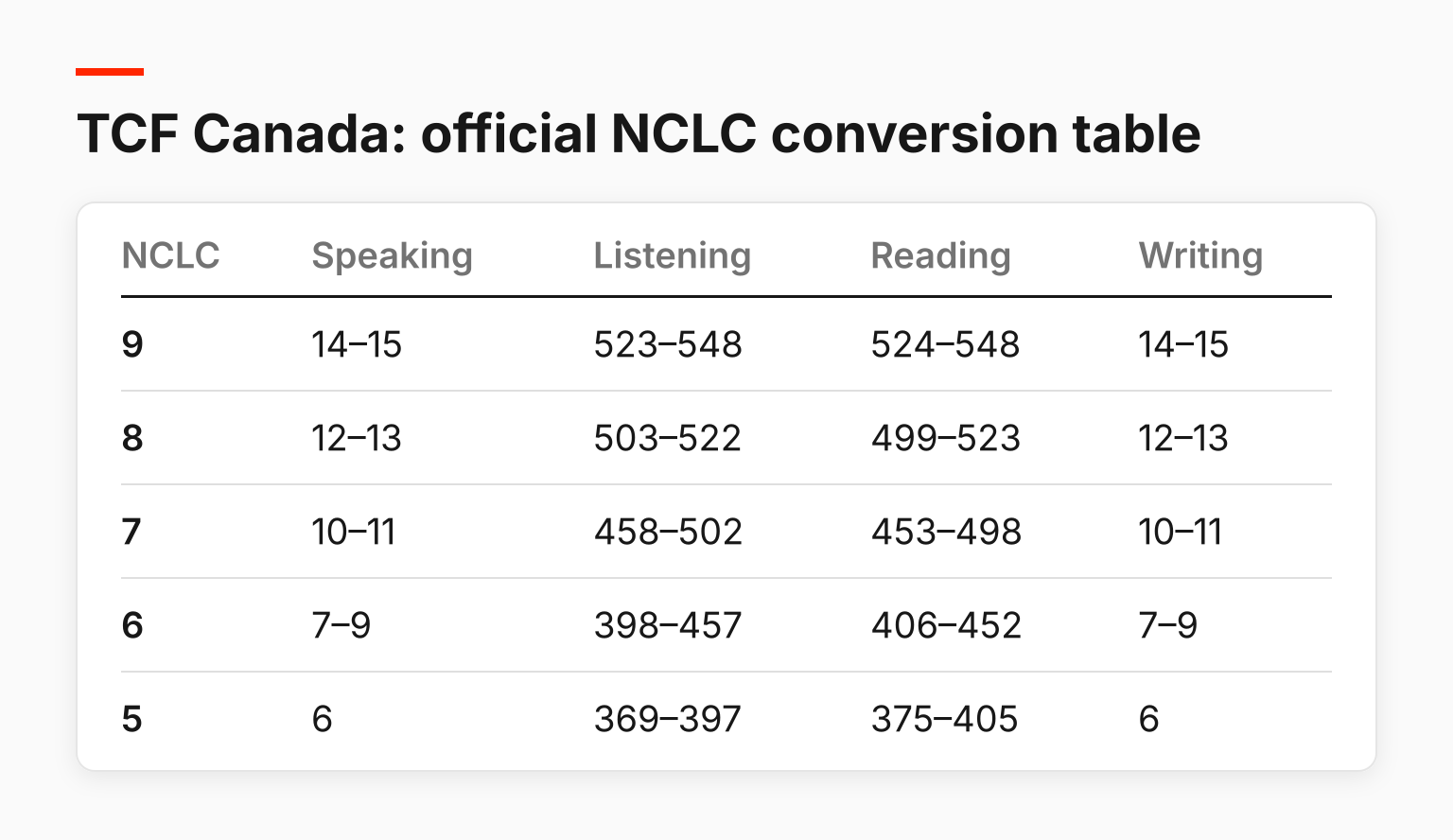
TCF Canada scores each skill on a different type of scale: speaking and writing use a 0–20 score, while listening and reading use a score out of 699. From IRCC's Express Entry language test page:
| NCLC | Speaking | Listening | Reading | Writing |
|---|---|---|---|---|
| 9 | 14–15 | 523–548 | 524–548 | 14–15 |
| 8 | 12–13 | 503–522 | 499–523 | 12–13 |
| 7 | 10–11 | 458–502 | 453–498 | 10–11 |
| 6 | 7–9 | 398–457 | 406–452 | 7–9 |
| 5 | 6 | 369–397 | 375–405 | 6 |
So the TCF Canada NCLC 7 score is 10–11 in speaking, 458–502 in listening, 453–498 in reading, and 10–11 in writing. If you are still choosing between the two exams, see TEF Canada vs TCF Canada: Which Test for Immigration? and the TCF Canada Guide (2026): Format, Scores & Immigration.
NCLC 7 side by side: TEF Canada vs TCF Canada
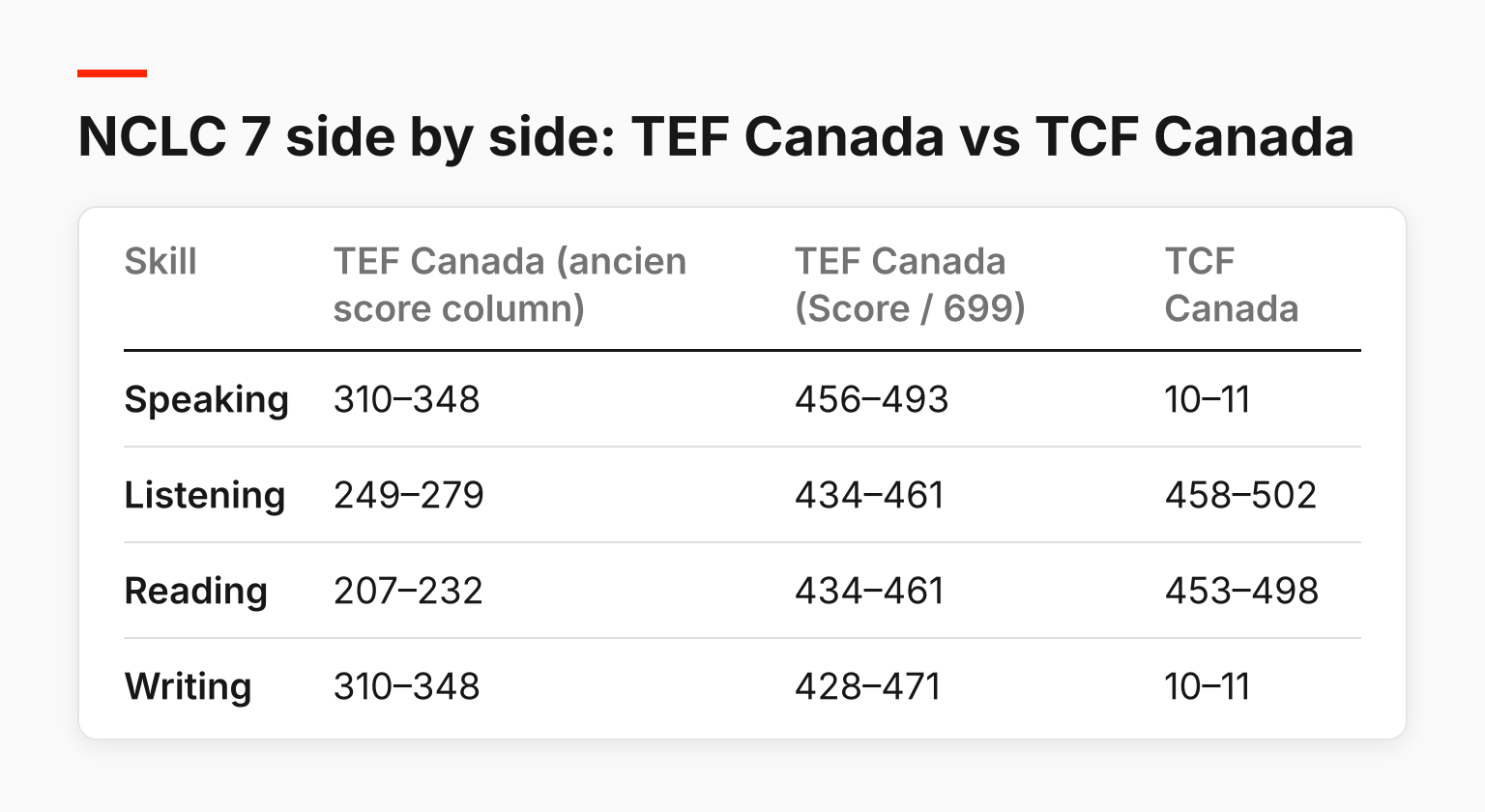
The two exams test the same four skills but score them on different scales, so the NCLC 7 row looks nothing alike. Here are the thresholds next to each other:
| Skill | TEF Canada (ancien score column) | TEF Canada (Score / 699) | TCF Canada |
|---|---|---|---|
| Speaking | 310–348 | 456–493 | 10–11 |
| Listening | 249–279 | 434–461 | 458–502 |
| Reading | 207–232 | 434–461 | 453–498 |
| Writing | 310–348 | 428–471 | 10–11 |
For Express Entry, always convert from the ancien score column for TEF. If you want more background on how the two exams differ beyond scoring, kochiva's TEF vs TCF explainer covers the format and admin differences.
Why there is no single “overall” score
IRCC never averages your four skills. It converts each skill independently, and every immigration rule that mentions NCLC 7 means NCLC 7 in all four skills. Speaking 12 on TCF with Writing 9 is not an average of NCLC 10.5; it is NCLC 9 and 7, and the 9 does not rescue the 7 for programs that require 7 everywhere.
This also means the threshold often feels lopsided. Many candidates hit 7 in reading easily but need months more work in speaking. Check your weakest skill first when you estimate readiness.
What NCLC 7 gets you in Express Entry
- Federal Skilled Worker Program floor: French as your first official language requires NCLC 7 in all four abilities.
- French-language category draws: Strong French is a category-based selection category, and NCLC 7+ in all four skills is the eligibility bar.
- CRS French bonus points: Per IRCC's CRS criteria, NCLC 7+ in all four French skills earns 25 additional points if you scored CLB 4 or lower in English (or did not take an English test), or 50 additional points if you scored CLB 5 or higher on all four English skills.
To see how this plays out on your own profile, the CRS French bonus calculator lets you plug in your scores and compare scenarios.
NCLC to CEFR: what B2-level performance looks like
NCLC 7 sits around CEFR B2. In practice, that means:
- Listening: you follow conversations and news reports on familiar topics at normal speed, including the accents and informal phrasing TEF and TCF use.
- Reading: you understand articles about work, immigration, and current events without looking up every third word.
- Writing: you write a structured letter or essay with clear arguments and connected sentences.
- Speaking: you explain a position, describe a plan, and hold a conversation with natural back-and-forth.
If you are currently A2 or B1, this is a reachable but real climb. The study guide How to Get NCLC 7 in TEF Canada (2026 Study Guide) breaks the path into skill-by-skill work.
Common mistakes when entering your scores
- Copying the “Score / 699” column from a TEF certificate into Express Entry. IRCC explicitly says to use the “Équivalence ancien score” column only, and warns that wrong scores can lead to refusal.
- Mixing up the TCF listening and reading ranges. They are close but not the same: NCLC 7 listening is 458–502, reading is 453–498. Enter each score against the right skill.
- Using an outdated pre-2023 table. Some older blog posts show different ranges or imply the /699 scale works for Express Entry. Always check the current IRCC page.
- Assuming one strong skill covers a weak one. IRCC evaluates each skill separately and never averages.
- Treating “CLB 7” and “NCLC 7” as interchangeable tables. The numbers match in name only; English and French tests convert on different grids.
Next step: practice toward your weakest skill
Find the skill where you are furthest from the NCLC 7 row, then drill that skill before anything else. Mock exams with per-section scoring tell you how close each skill actually is, so you can see which row you are in today and how much ground is left.
If you want structured practice with NCLC tracking built in, you can start free practice with 1,000 credits at CanadaFrenchPath. It covers all four skills for TEF Canada and TCF Canada with mock exams, section drills, and feedback on where you stand against the NCLC 7 thresholds.