
Summary of the Article
- French as your second official language: 3 points per ability at NCLC 7, so 12 across four skills, plus the bonus.
- French as your first official language: 17 points per ability without a spouse (16 with), so 68 (or 64) across four skills, plus the bonus.
- The bonus: 25 points for NCLC 7 or higher in all four French skills, and 50 total when your English is CLB 5 or higher in all four abilities. Any other English result still earns the base 25.
- All-or-nothing on the French side: one French ability below NCLC 7 zeroes the entire bonus.
- The French-language category draw: NCLC 7 in all four skills makes you eligible for French-only invitation rounds, which can cut off far lower than general draws, but eligibility itself adds no CRS points.
The Short Answer
If you reach NCLC 7 in all four French skills (listening, reading, writing, speaking) on an approved test such as TEF Canada or TCF Canada, three things happen in the Comprehensive Ranking System (CRS):
- You earn core language points, either as your first official language (17 points per ability without a spouse) or your second (3 points per ability).
- You earn additional French points: 25 for clearing NCLC 7 in all four skills, plus another 25 (50 total) when your English is CLB 5 or higher in all four abilities.
- You become eligible for French-language category draws, where IRCC invites only candidates with NCLC 7+ in all four skills.
The exact total depends on which language you declare as your first official language and how strong your English is. Let's break it down.
Core Language Points: First vs Second Official Language
When you create your Express Entry profile, you pick which of your two test results counts as your first official language. That choice changes the math a lot. The official CRS criteria set these values per ability at NCLC/CLB 7:
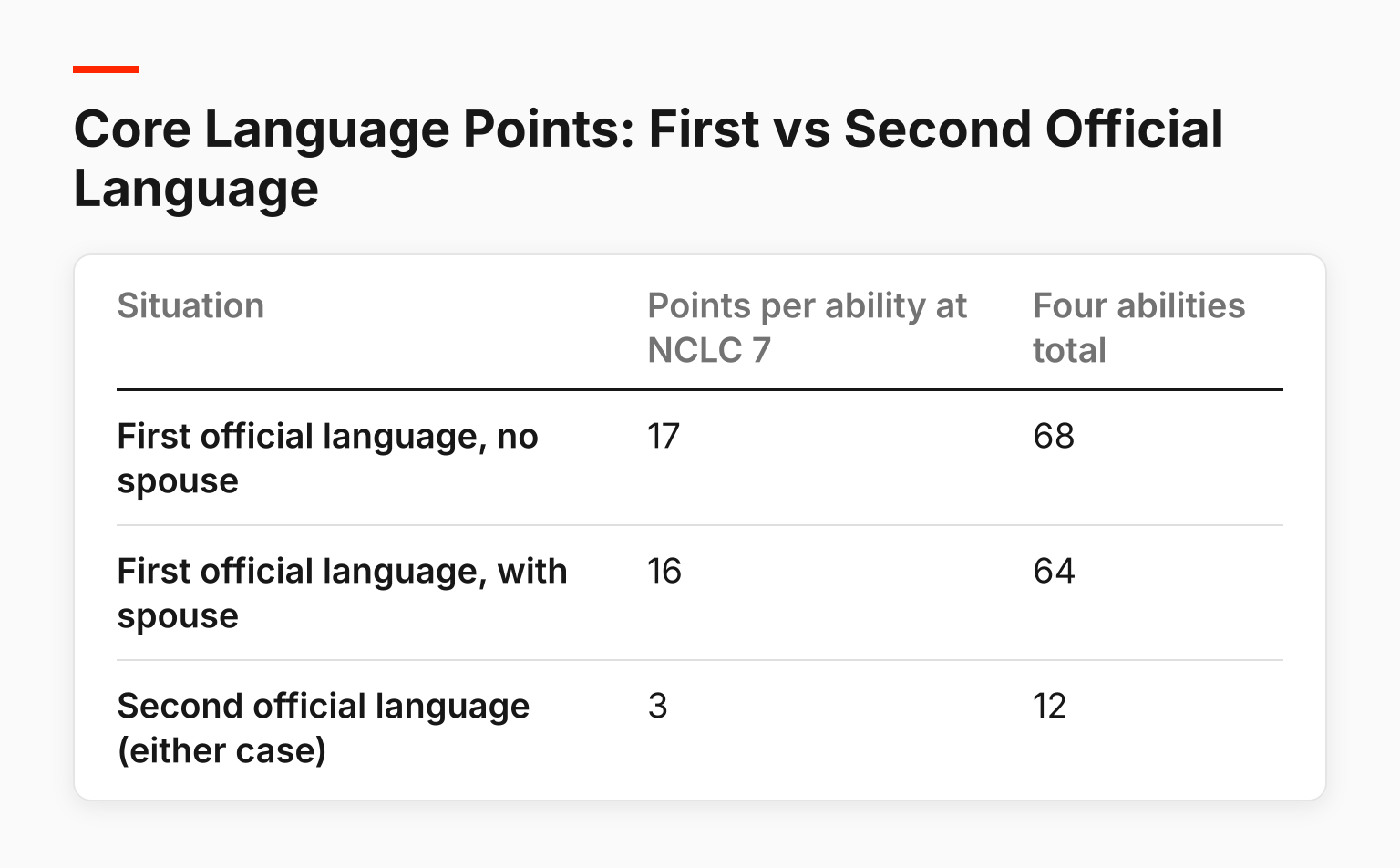
| Situation | Points per ability at NCLC 7 | Four abilities total |
|---|---|---|
| First official language, no spouse | 17 | 68 |
| First official language, with spouse | 16 | 64 |
| Second official language (either case) | 3 | 12 |
Two notes on the second-language column. First, the per-ability value is the same with or without a spouse. Second, second-language points are capped: at a combined maximum of 24 points without a spouse and 22 with one. The cap only matters at higher French levels (NCLC 9+ earns 6 points per ability, which hits the spouse cap), so at exactly NCLC 7 you get the full 12 either way.
IRCC's own advice on the francophone Express Entry page is to name your strongest language as your first official language, because that is where the points per ability are biggest.
If you have TEF or TCF scores and want to see which NCLC level they map to, our TEF and TCF to NCLC conversion guide shows the exact score bands for NCLC 7.
The Additional French Bonus: +25 or +50
This is the part most people mean when they ask about "NCLC 7 French bonus points." Under the additional factors of the CRS, the bonus is built in two steps. IRCC's current Ministerial Instructions, dated October 15, 2026, award 25 points when your French is NCLC 7 or higher in all four skill areas, plus 25 more when your English is CLB 5 or higher in all four skill areas. That works out to the 25 and 50 values shown on the CRS criteria page:
| Your French result | Your English result | Bonus points |
|---|---|---|
| NCLC 7+ in all four skills | CLB 5+ in all four abilities | +50 |
| NCLC 7+ in all four skills | Anything short of that (CLB 4 or lower, mixed results, or no English test) | +25 |
| One or more abilities below NCLC 7 | Any result | 0 |
The same additional-factors section also rewards a Canadian sibling (15 points) and Canadian education (up to 30 points), so the French bonus is often the largest additional factor you can directly influence through study.
The All-or-Nothing Rule
The two halves of the rule are not equally strict:
- The French half is all-or-nothing. If even one French ability lands at NCLC 6 or below, you get 0 bonus points, not a partial amount. Someone who scores NCLC 7, 7, 8, 6 gets nothing. That one weak skill is often writing or listening, and it is fixable with targeted practice.
- The English half is not all-or-nothing. English decides between the two tiers, not whether you get points. If your English is CLB 5+ in all four abilities, you get the full 50. Any other English result, including a mix such as three skills at CLB 5 and one at CLB 4, or no English test at all, still earns the base 25. So one weak English skill costs you 25 points, not the whole bonus.
One caution on reading the tables: IRCC's CRS criteria table lists the 25-point row as "CLB 4 or lower in English or no English test." The Ministerial Instructions word it as a base 25 plus a conditional 25. If your English results fall in a mixed band, rely on the Ministerial Instructions wording and confirm your case in IRCC's official calculator before you count on either number.
If you are at B1 or B2 in French right now, our NCLC 7 study guide lays out how to close the gap skill by skill.
Worked Examples
Here is what the rules look like for three common profiles. All use NCLC 7 in every French ability.
Example 1: English-Dominant Single Applicant
- English first official language at CLB 9 in all four skills: 31 points per ability = 124 core points (not French-attributable, but context).
- French second official language at NCLC 7: 3 × 4 = 12 points.
- English is CLB 5+ everywhere, so the bonus is +50.
- French-attributable total: 62 points.
Example 2: Same Profile, With a Spouse
- French second official language at NCLC 7: still 12 points. The per-ability rate for a second official language does not change when you have a spouse, and 12 sits comfortably under the 22-point spousal cap.
- Bonus: still +50. The bonus is based on your own English test results, and adding a spouse to your profile does not change those scores.
- French-attributable total: 62 points.
The spousal cap starts to matter at higher French levels. At NCLC 9 in French as a second language, you would earn 6 per ability, which means 24 without a spouse but 22 with one. That is one reason pushing from NCLC 7 to 9 in French is so valuable: the per-ability rate doubles.
Example 3: French-First Profile
If French is genuinely your stronger language, declare it first:
- First official language at NCLC 7: 17 × 4 = 68 points (64 with an accompanying spouse).
- If English is CLB 5+ in all four abilities: +50, for 118 total.
- Any other English result, including a mixed profile or no English test: +25, for 93 total.
The 68 + 25 case is where the often-quoted "about 93 points" figure comes from: strong French alone, no meaningful English test.
The Category Draw: Not Points, but Odds
Eligibility for the French-language proficiency category requires NCLC 7 or higher in all four skills on an approved test. It adds no CRS points. What it changes is which pool you compete in. French-language draws have repeatedly invited candidates at much lower CRS cut-offs than general draws; for example, the French-language draw of April 29, 2026 invited 4,000 candidates with a lowest score of 400, per IRCC's invitation rounds page. A general-draw cut-off is usually far above that.
So think of NCLC 7 as doing two jobs: it adds bonus points to your score, and it opens a separate, often easier door. For the broader case for French in an immigration strategy, see Is Learning French a Cheat Code for Canadian PR?
Only TEF Canada and TCF Canada Count
IRCC accepts exactly two French tests for Express Entry: TEF Canada and TCF Canada. A CEFR certificate from a language school, a DELF/DALF diploma, or a university course grade does not count for CRS points, even if it says C1. Your test results must also be less than two years old when you submit your profile and your application, so timing matters: a test taken too early can expire before you're invited.
What Could Change
One caution. There has been public discussion in 2026, including third-party reports of an IRCC consultation in spring 2026, about possibly changing the 25/50 French bonus structure. As of the latest check, the Ministerial Instructions dated October 15, 2026 still set the bonus at 25 points plus 25 more, and the official CRS criteria page still shows the 25 and 50 values. Every number in this article comes from those two pages. Because CRS rules can change, always re-check canada.ca right before you make a study or test-booking decision based on point math.
Test Your Own Numbers
The fastest way to see what French is worth in your actual profile is to plug in your scores. Our free CRS French bonus calculator works through the first-vs-second language choice, the bonus tiers, and the caps for you, and our NCLC 7+ time estimator tells you how long it typically takes to get there from your current level.
If the numbers convince you that NCLC 7 is worth chasing, the next step is structured practice across all four skills, because the all-or-nothing rule means your weakest French skill sets your bonus. You can start free practice with 1,000 credits on CanadaFrenchPath, with mock exams, AI grading, and tutor feedback built around the TEF Canada and TCF Canada formats.