
TL;DR
A focused TEF Canada preparation plan can take you from roughly A2 or B1 to NCLC 7+ in about 12 weeks if you can study 8 to 12 hours per week. The plan below works in three phases: foundations with question-type practice, timed skill drilling, then full mock exams with error review. Your weakest skill sets the schedule, not the exam as a whole.
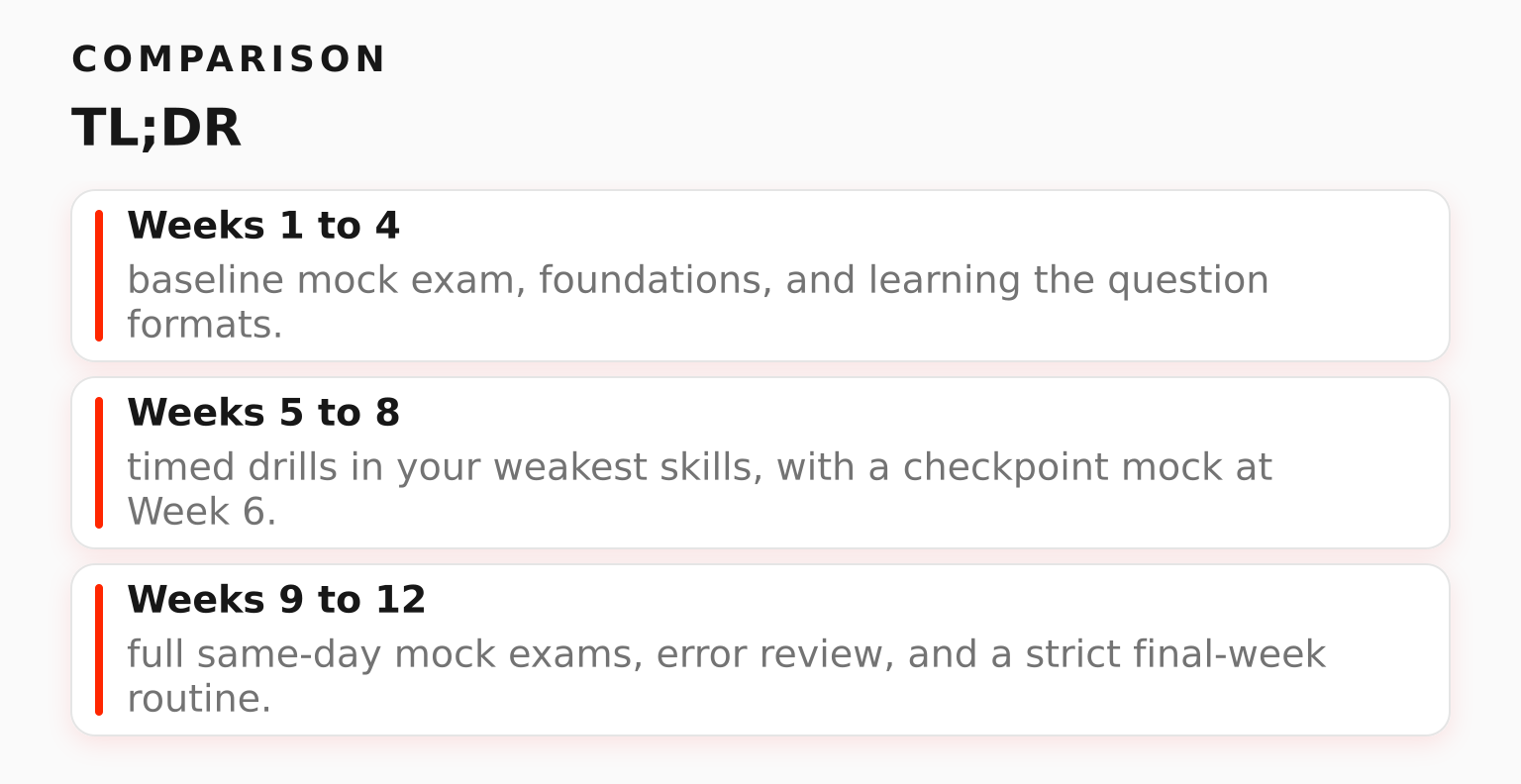
- Weeks 1 to 4: baseline mock exam, foundations, and learning the question formats.
- Weeks 5 to 8: timed drills in your weakest skills, with a checkpoint mock at Week 6.
- Weeks 9 to 12: full same-day mock exams, error review, and a strict final-week routine.
If your baseline is lower or you have fewer hours, stretch the plan rather than compress it. The time estimator on CanadaFrenchPath can size the timeline to your own level and weekly availability.
Start With the Exam, Not the Language
The TEF Canada is a standardized test with fixed formats and timing. That changes how you should study. General French improvement helps, but the fastest score gains come from knowing exactly what the exam asks of you.
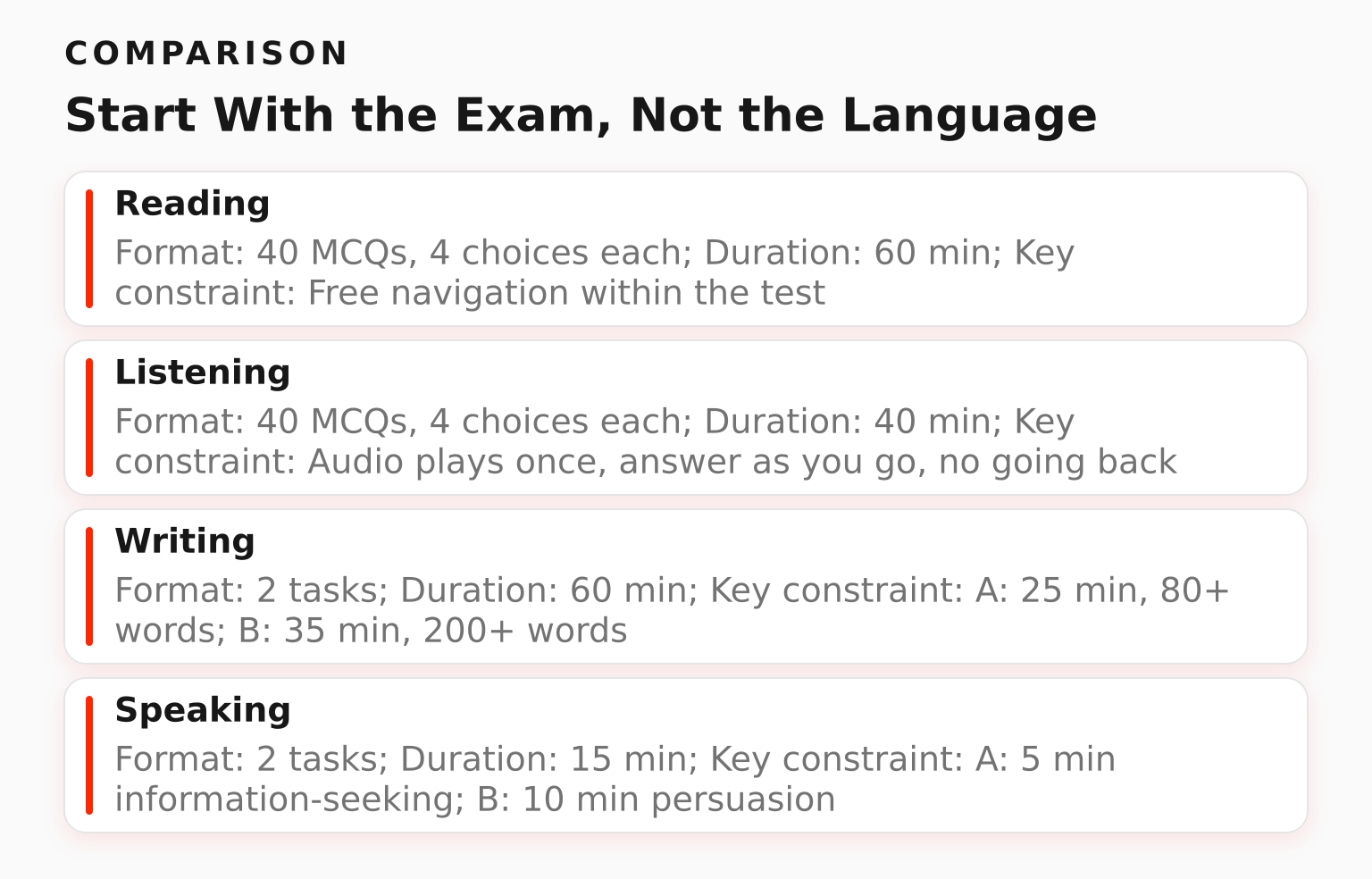
For immigration, you take all four sections in one session. Test centers require the full set on the same day for your results to be recognized by Canadian authorities, as the Université de Montréal test center explains for its own sessions. Here is the official format, per the Le français des affaires exam page:
| Section | Format | Duration | Key constraint |
|---|---|---|---|
| Reading | 40 MCQs, 4 choices each | 60 min | Free navigation within the test |
| Listening | 40 MCQs, 4 choices each | 40 min | Audio plays once, answer as you go, no going back |
| Writing | 2 tasks | 60 min | A: 25 min, 80+ words; B: 35 min, 200+ words |
| Speaking | 2 tasks | 15 min | A: 5 min information-seeking; B: 10 min persuasion |
Two details drive a lot of strategy. First, in the listening section you cannot revisit a question. Once the audio moves on, that question is gone, so you must answer in real time. Second, both MCQ sections score a wrong answer and a blank answer the same: zero points, no penalty. Never leave a blank; guess before the audio moves on.
Your results convert to NCLC levels per skill, and there is no overall score. The official Express Entry language requirements on Canada.ca list the minimum NCLC level for each of the four abilities separately, which means your weakest section decides when you are ready. If you want a deeper explanation of what NCLC 7 means and how to reach it from A2 or B1, see How to Get NCLC 7 in TEF Canada.
One more reason this target is worth the work: IRCC notes that NCLC 7 or higher in all four French skills earns you 25 additional Express Entry points if your English is CLB 4 or lower, or 50 additional points if you scored CLB 5 or higher in all four English skills. You can preview your own bump with the CRS calculator on CanadaFrenchPath.
Week 0: Take a Baseline Mock Exam
Before week one, sit a full-length mock exam under real conditions: strict timing, no dictionary, no pauses. This is not about the score. It answers three questions:
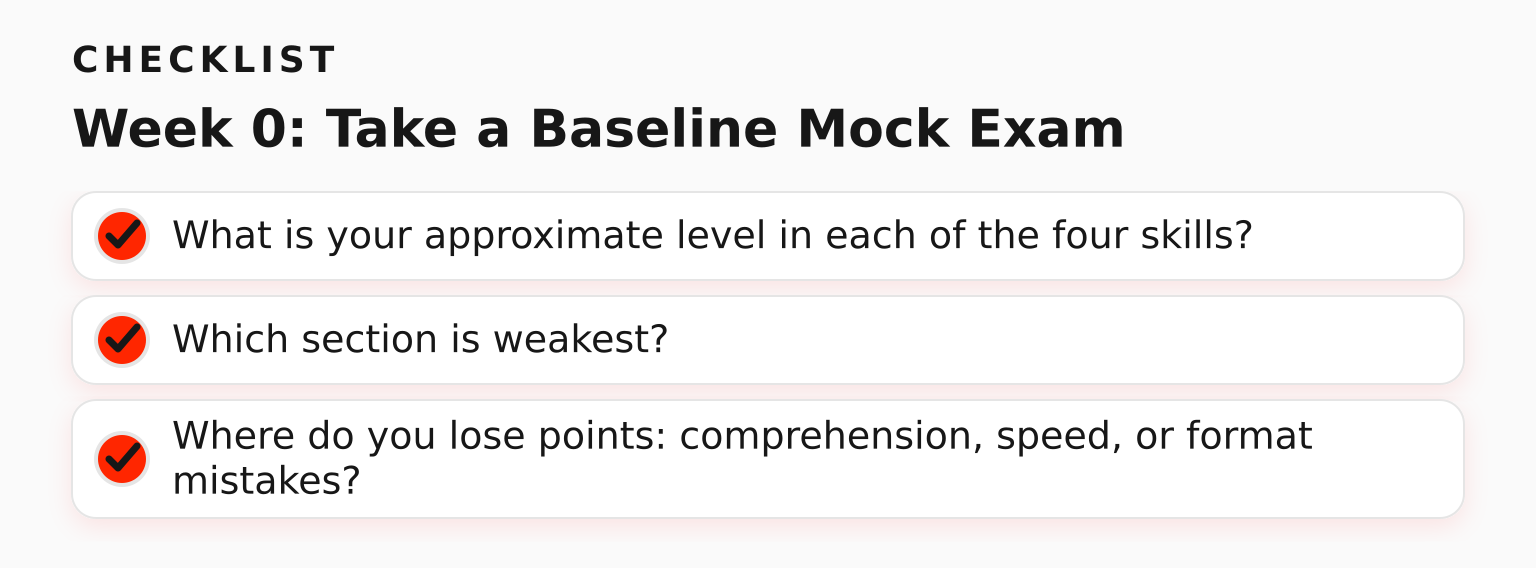
- What is your approximate level in each of the four skills?
- Which section is weakest?
- Where do you lose points: comprehension, speed, or format mistakes?
Map your results roughly like this:
| Baseline | What it means for your plan |
|---|---|
| NCLC 3 or below in any skill | Extend the timeline; build foundations first (see below) |
| NCLC 4 to 5 across the board | The 12-week plan fits with 8 to 10 hours per week |
| NCLC 6 in most skills | Compress toward 8 weeks, or bank the extra weeks for mock exams |
If you need help finding good practice material for the baseline and later checkpoints, the best TEF Canada practice exams guide compares free and paid options.
Your Time Budget
Plan on 8 to 12 hours per week for 12 weeks. Fewer than 6 hours per week tends to stretch the timeline considerably, because listening and speaking improve slowly and need frequent, repeated exposure.
Split your time by leverage, not equally. Give your weakest skill about 40 percent of your weekly hours. Listening keeps a floor no matter what: it is the section most candidates underestimate, it improves the slowest, and the one-play, no-going-back format punishes hesitation.
| Skill | Share of weekly time | Example at 10 h/week |
|---|---|---|
| Your weakest skill | 40% | 4 hours |
| Listening (if it is not your weakest) | 20% | 2 hours |
| Speaking (if it is not your weakest) | 20% | 2 hours |
| The remaining two skills, split | 20% | 2 hours total |
If listening or speaking is your weakest skill, it simply takes the 40 percent share, and the other one keeps its 20 percent. Whatever is left splits between reading and writing.
Here is what a 10-hour week can look like in practice:
| Day | Focus | Time |
|---|---|---|
| Monday | Weakest skill drill | 1 h |
| Tuesday | Listening under exam conditions | 1 h |
| Wednesday | Weakest skill drill | 1 h |
| Thursday | Reading + vocabulary by theme | 1.5 h |
| Friday | Speaking practice, recorded | 1 h |
| Saturday | Writing task with corrections | 1.5 h |
| Sunday | Review the week's errors | 1 h |
| Any day | 15 min of French audio exposure | daily |
Phase 1: Weeks 1 to 4, Foundations and Question Types
The goal of this phase is functional French plus format familiarity. Do not chase exam tricks yet.
- Vocabulary by theme. Study high-frequency TEF themes: work, housing, transportation, health, government services, travel, education. Recognizing topic vocabulary is what makes reading and listening passages tractable. For themed lists that match the exam, see TEF Canada vocabulary by theme.
- Grammar that supports communication. Present, past, and future tenses, the conditional, question structures, negation, and connectors. You do not need perfect grammar to score NCLC 7. You need reliable sentences.
- Question-type familiarity. Work through each section's formats once or twice untimed so nothing surprises you later. Reading MCQs reward scanning and elimination. Writing Task A asks you to continue an article in 80+ words in 25 minutes; Task B asks you to state and justify an opinion in 200+ words in 35 minutes.
- Daily listening exposure. Even 15 minutes a day of French audio builds the ear. Start now, in week one, not week six.
- Speaking from day one. Ten to fifteen minutes daily. Record yourself answering simple prompts. The point is reducing hesitation, not sounding perfect.
Phase 2: Weeks 5 to 8, Timed Drilling
Now the pressure turns on. Every session should resemble the exam it trains.
- Listening: timed sets of TEF-style questions, one play only. Practice predicting what kind of information the question wants before the audio starts, and committing to an answer immediately.
- Reading: full 40-question sets against the 60-minute clock. Learn your pace markers, such as where you should be at 30 minutes.
- Writing: one Task A and one Task B per week, minimum, each corrected. One corrected task teaches you more than five uncorrected ones. The TEF Canada writing cheat sheet covers structure and useful phrases for both tasks.
- Speaking: weekly full run-throughs of both tasks. Section A is a 5-minute information-seeking conversation; Section B is a 10-minute argument to persuade. If you want a framework for structuring your answers, the TEF Canada speaking cheat sheet breaks down both sections.
Checkpoint: Week 6 mock exam. Take a full timed mock. What you want to see: your weakest skill has moved up roughly one NCLC level from baseline, and you are finishing sections within time, even if accuracy is not there yet. If nothing moved, do not keep pushing the same plan. Re-diagnose: are you reviewing errors, or just doing more questions?
Phase 3: Weeks 9 to 12, Mock Exams and Error Review
The last month is about validation and consistency.
- Full same-day mocks. At Weeks 9, 10, and 12, take a complete mock with all four sections in one sitting. Test-day fatigue is real, and the only cure is having done it before.
- Error review as the main activity. For every mock, build an error log: the question, why you missed it, and the rule or word behind it. Review the log before each new mock. Improvement happens during review, not while answering.
- Repeat themes, not new material. Cycle the same high-frequency vocabulary themes so recognition becomes automatic.
- Timing rehearsal. Practice the listening rhythm specifically: answer as you go, guess rather than freeze, move on.
Checkpoint: Week 10 mock exam. You want scores at or above your target in at least three skills and your weakest skill within one band of target. If yes, book your exam date with confidence. If not, you have two weeks to fix a specific, known weakness, which is exactly what the error log is for.
Adapt the Plan to Your Baseline
The 12-week structure is a planning choice, not an official rule. Adjust it:
- Starting below A2? Add a foundations block of 4 to 8 weeks before Phase 1. Doing full mock exams while you cannot yet follow basic conversations wastes material and morale.
- Already NCLC 6 across the board? Compress to 8 weeks and spend the saved weeks on mocks and error review.
- Fewer than 8 hours per week? Keep the phases but stretch them, and protect listening and speaking time first. Those two skills decay fastest when you skip them.
- Plateauing mid-plan? It usually means volume without feedback. Cut question count and double your correction time. For more tactics on breaking through, see why most TEF Canada candidates plateau.
If you are studying without a tutor, the self-study method guide pairs well with this plan, and the broader TEF Canada study strategies article covers tactics this plan assumes you already know.
Final-Week Checklist
No new material in the last week. You are managing energy and logistics now. This is your TEF Canada preparation checklist for the final stretch:
| Day before the test | Test day |
|---|---|
| Confirm ID, exam center address, arrival time | Arrive early, documents ready |
| Light review of your error log only | Same-day, four-section format, all in one session |
| Full run of one speaking task, no more | Answer listening questions as they come; guess, never blank |
| Prep ID, water, snacks, transport plan | Watch the clock: 40 listening Qs in 40 min, 40 reading Qs in 60 min |
| Sleep 7 to 8 hours | Writing: 80+ words in 25 min, then 200+ words in 35 min |
| No practice exam the night before | Speaking: 5 min information-seeking, then 10 min persuasion |
Two habits worth keeping on test day: never leave an MCQ blank, since a wrong answer costs you nothing, and in listening, commit to an answer before the next audio starts.
FAQ
Is 12 weeks enough to prepare for TEF Canada? For most candidates starting around A2 or B1 with 8 to 12 focused hours per week, yes. Below that level, extend the timeline rather than rushing the same plan.
How many hours per week do I need for NCLC 7? Around 8 to 12 per week over 12 weeks is a realistic range for an A2/B1 start. More important than the total is weighting your weakest skill at roughly 40 percent and reviewing errors consistently.
Should I study all four skills every day? No. Rotate them across the week and give your weakest skill the largest share. Daily listening exposure and short speaking practice are the two things worth doing every day.
Your Next Step
The plan only works if you actually practice, and the cheapest way to start is free. Sign up on CanadaFrenchPath to start free practice with 1,000 credits: section drills, mock exams, and feedback across all four skills. And if you are not sure whether 12 weeks fits your situation, run your baseline and weekly hours through the NCLC 7+ time estimator before you book anything.