
TL;DR
You can train your ear to catch French numbers in TEF Canada and TCF Canada listening, even though each audio plays only once. Most number mistakes come from a few fixable causes: similar-sounding pairs, the 70-99 counting system, liaison, and self-corrections by the speakers.
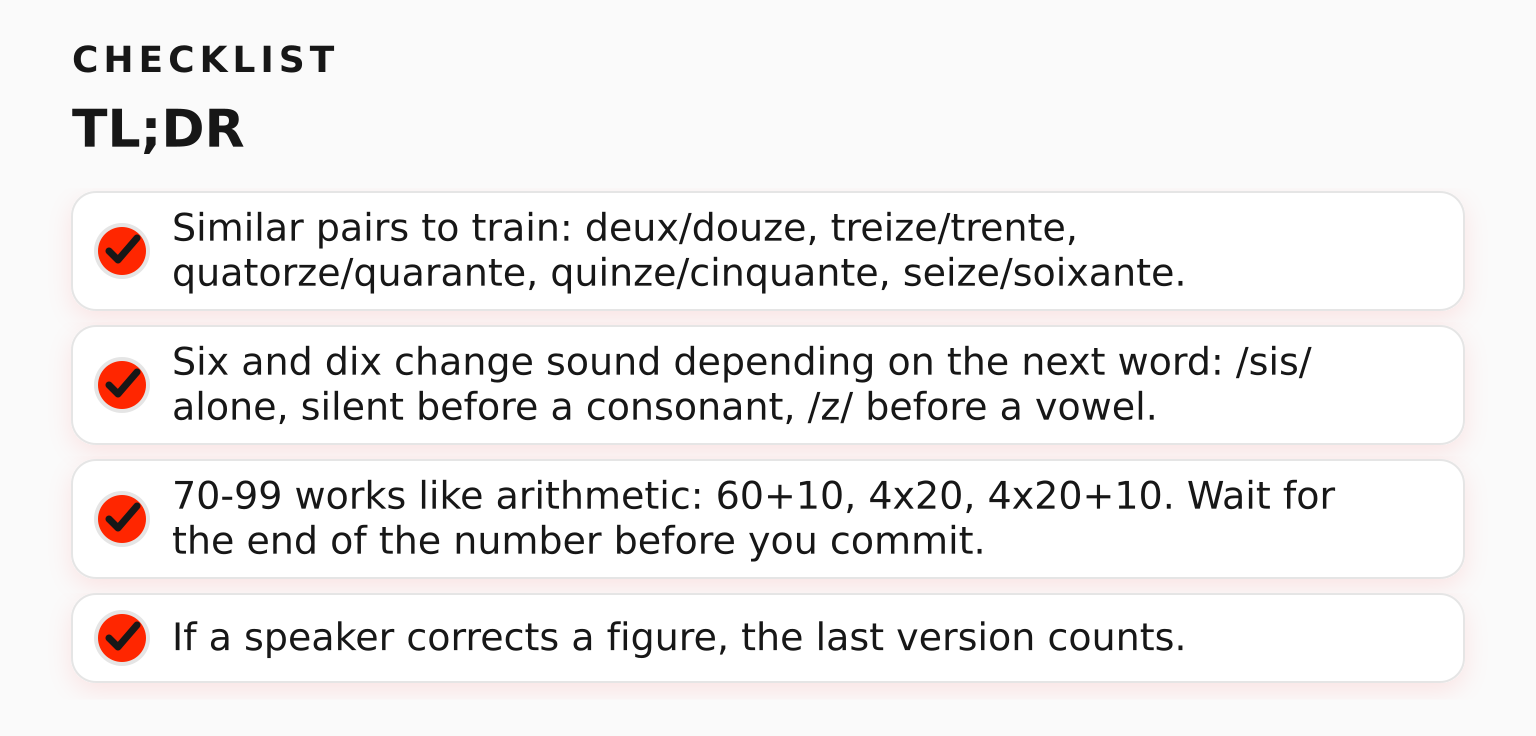
- Similar pairs to train: deux/douze, treize/trente, quatorze/quarante, quinze/cinquante, seize/soixante.
- Six and dix change sound depending on the next word: /sis/ alone, silent before a consonant, /z/ before a vowel.
- 70-99 works like arithmetic: 60+10, 4x20, 4x20+10. Wait for the end of the number before you commit.
- If a speaker corrects a figure, the last version counts.
Why numbers cost easy points on exam day
In the TEF and TCF listening sections, each document plays once. If a question hangs on one figure (a time, a price, a platform number, a date) and you mishear it, you lose that answer even if you understood the rest of the message. That makes numbers one of the cheapest places to gain points with focused practice.
Numbers also appear in almost every early listening document: station announcements, voicemails, shop conversations. You cannot avoid them. You can, however, learn the specific ways spoken French makes them hard, then drill those exact weaknesses.
How six and dix actually sound
Some French numbers change pronunciation depending on what comes next. Six and dix are the clearest example, and this alone explains many "I know that word, why didn't I recognize it?" moments.
- Alone or at the end of a phrase: six is /sis/, dix is /dis/. Full final consonant.
- Before a consonant: the final sound drops and the vowel shortens. Six livres sounds like /si/, dix minutes like /di/.
- Before a vowel: liaison adds a /z/. Six oranges becomes /siz/, dix ans becomes /diz/.
The same written number has three spoken forms, so if you only memorized "sis," you will not recognize "si livres" or "si-z oranges" in exam audio. The French number pronunciation rules at numbersinfrench.com document this three-context pattern in detail, including huit (t drops before consonants) and vingt (t appears only before vowels, as in vingt euros).
High-confusion pairs to train first
These pairs sound close enough in fast speech to be a real risk. For each one, know the one feature that tells it apart.
| Pair | What makes them different |
|---|---|
| deux / douze | douze has two syllables and ends in a [z] sound |
| treize / trente | treize ends in [z], trente ends in [t] |
| quatorze / quarante | quatorze has three syllables |
| quinze / cinquante | quinze starts with [k], cinquante with [s] |
| seize / soixante | seize ends in [z], soixante ends in [t] |
| soixante et onze / quatre-vingt-onze | listen for the first word: soixante or quatre-vingt |
Seize versus soixante is worth special attention: 16 and 60 look nothing alike on paper, but spoken they share the same opening sound. In fast speech the ending can get swallowed, so train yourself to catch that final [t] before you guess.
The 70-99 system as arithmetic, not a list
French numbers from 70 to 99 are built on counting in twenties, which is why they feel so strange. Don't memorize thirty words. Learn the formula:
| Number | Spoken as | Meaning |
|---|---|---|
| 70 | soixante-dix | 60 + 10 |
| 71 | soixante et onze | 60 and 11 |
| 80 | quatre-vingts | 4 x 20 |
| 81 | quatre-vingt-un | 4 x 20 + 1 (no "et") |
| 90 | quatre-vingt-dix | 4 x 20 + 10 |
| 91 | quatre-vingt-onze | 4 x 20 + 11 |
| 97 | quatre-vingt-dix-sept | 4 x 20 + 17 |
Two habits make this work in listening. First, wait for the end: "soixante... dix-sept" is 97, but you can only know that once the second half arrives. Second, note the "et" behavior: 71 is "soixante et onze," but 81 and 91 drop the "et" (quatre-vingt-un, quatre-vingt-onze).
One more possibility to keep in mind: if the audio uses a Belgian or Swiss speaker, you may hear septante (70) or nonante (90) instead of soixante-dix and quatre-vingt-dix. This is uncommon in standard French exam audio, but knowing the forms costs you nothing. The 70 to 99 guide at numbersinfrench.com covers the full structure if you want more depth.
Phone numbers, prices, and dates
Phone numbers are read in pairs. 06 12 34 56 78 sounds like "zéro six, douze, trente-quatre, cinquante-six, soixante-dix-huit." This creates a famous trap: soixante-dix-huit (78) and soixante-huit (68) differ by one word buried in fast speech. Practice writing numbers in pairs as you hear them, not digit by digit.
Prices often come in two parts: "trois euros cinquante" (3.50 euros). The number you need may not be the first figure you hear. Always listen for the unit too (per kilo, per person, per month), because a question can hinge on it, not the amount.
Dates and times bring two traps. Announcements use the 24-hour clock (quinze heures = 3 p.m.), while a conversation may say "trois heures." And date phrases can flip the meaning of an entire question: "à partir du 12 mars" (starting March 12) and "jusqu'au 12 mars" (until March 12) point in opposite directions. Catch the preposition, not just the date.
The correction trap: the first figure is often a distractor
Exam audio loves this pattern: a speaker states a figure, then changes it.
- "Rendez-vous à 15 heures... pardon, finalement, c'est à 17 heures."
- "C'est 20 euros... ah non, au lieu de 20, c'est plutôt 25."
The final version counts. Cue words to listen for include finalement, pardon, en fait, au lieu de, and non, c'est. When you hear a correction, cross out the first figure in your notes and anchor on the last one. A TCF listening lesson on numbers, prices and times highlights this same rule: when two figures are said, the question usually matches the one that came last.
A three-step method for exam day
- Before listening: read the answer options. If they include 13 h, 15 h and 30 h, you already know you need to separate treize, quinze, and trente.
- While listening: don't commit to a number the moment it starts. Wait for its end (soixante... dix-sept), and catch the unit and any preposition.
- After listening: if two figures were said, resolve the correction. Ask which one came last and which one matches the question exactly.
This works because the audio is designed to test whether you follow the whole number, not whether you catch its first syllable.
A daily drill routine (about 10 minutes)
Do these three drills each day until numbers stop feeling like a scramble:
- Digit dictation (2-3 minutes): play any French audio and write every number you hear as digits. Phone numbers from real voicemails are ideal because of the pair structure.
- 70-99 listen-and-write (3-4 minutes): drill only this range until soixante-dix-sept and quatre-vingt-dix-huit produce automatic digit answers. This is where the arithmetic becomes reflex.
- Exam-condition practice (3-4 minutes): take one listening document you play exactly once, no pausing, and answer the number questions with the three-step method above.
If your scores stay uneven after a few weeks, the problem may be bigger than numbers. Why most TEF Canada candidates plateau explains how to diagnose which skill is really holding you back. For a full routine that fits drills like these into a working week, see the self-study guide for TEF Canada.
Where to get number-heavy listening practice
Drills only build an ear if the audio resembles the exam: single-play documents, real prices and times, and corrections built in. Pair number drills with a quick vocab warm-up like French Hangman or our other word games.
When you're ready for full documents, look at how to find the best TEF Canada practice exams, free and paid to pick material that matches the real format.
CanadaFrenchPath also offers listening drills and mock exams across all four skills. Sign up to start free practice with 1,000 credits and turn today's routine into measurable progress toward NCLC 7+.
Frequently asked questions
What is 6 in French?
Six is "six" in French, pronounced /sis/ alone or at the end of a phrase. Before a consonant it sounds like /si/ (six livres), and before a vowel the s becomes a /z/ sound (six oranges).
Why are 70, 80, and 90 so hard in French listening?
They follow a base-20 structure: soixante-dix (60+10), quatre-vingts (4x20), and quatre-vingt-dix (4x20+10). Train the arithmetic and wait for the end of each number instead of memorizing the block as thirty separate words.
How can I practice French numbers listening for TEF Canada?
Spend about ten minutes a day on three drills: digit dictation from real audio, a 70-99 listen-and-write drill, and one single-play listening document answered with a before/during/after method. Exam-like material matters more than volume, since real TEF and TCF audio plays only once.