
Summary of the Article
- Present tense: je suis, tu es, il/elle/on est, nous sommes, vous êtes, ils/elles sont.
- High-value tenses: j'étais (imparfait), je serai (futur), je serais (conditionnel), and j'ai été, because être itself takes avoir.
- Être as an auxiliary: verbs like aller, venir, sortir, and rester use être, so you write elle est allée, with agreement.
- The trap: monter, descendre, sortir, entrer, rentrer, retourner, and passer switch to avoir when a direct object follows.
If you master these two things, you remove a whole category of errors from your writing and speaking sections. Here is the full reference, with exam examples throughout.
Être in the Present Tense: The Chart You Need First
You will use the present tense of être in almost every sentence you say or write on the exam: in your self-introduction, in formal letters (Je suis assistant de direction depuis trois ans), and in listening transcripts.
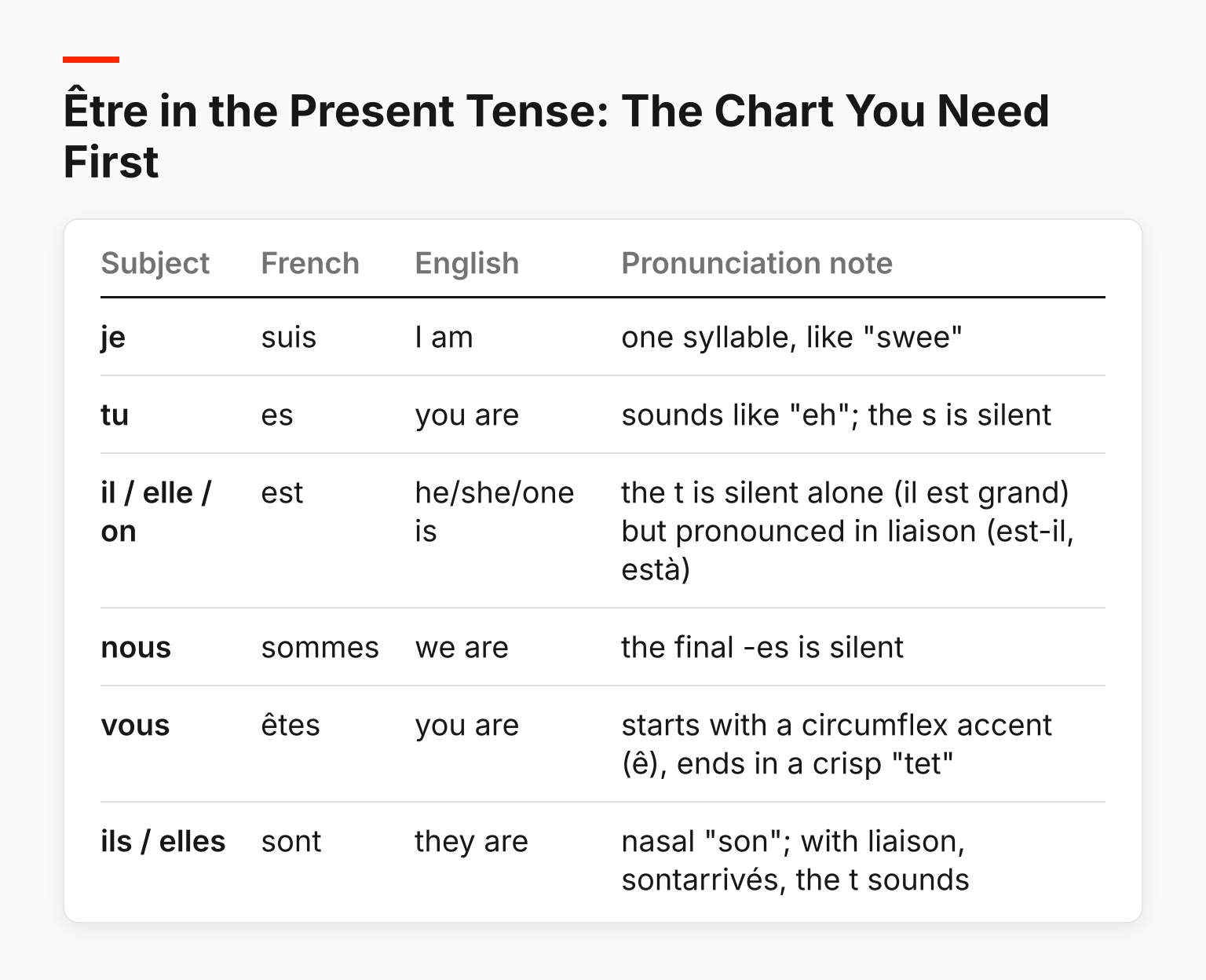
| Subject | French | English | Pronunciation note |
|---|---|---|---|
| je | suis | I am | one syllable, like "swee" |
| tu | es | you are | sounds like "eh"; the s is silent |
| il / elle / on | est | he/she/one is | the t is silent alone (il est grand) but pronounced in liaison (est-il, est_à) |
| nous | sommes | we are | the final -es is silent |
| vous | êtes | you are | starts with a circumflex accent (ê), ends in a crisp "tet" |
| ils / elles | sont | they are | nasal "son"; with liaison, sont_arrivés, the t sounds |
Two notes that pay off fast. First, tu es, il est, and et all sound nearly identical in fast speech, which matters for the listening section below. Second, if you want the complete tense tables beyond what this guide covers, the Lawless French être conjugation page and the Reverso conjugator for être list every form, including rare literary tenses you will not need on TEF or TCF.
Être in the Tenses That Actually Show Up on TEF and TCF
You do not need every tense for the exam. You need these four, plus two quick mentions.
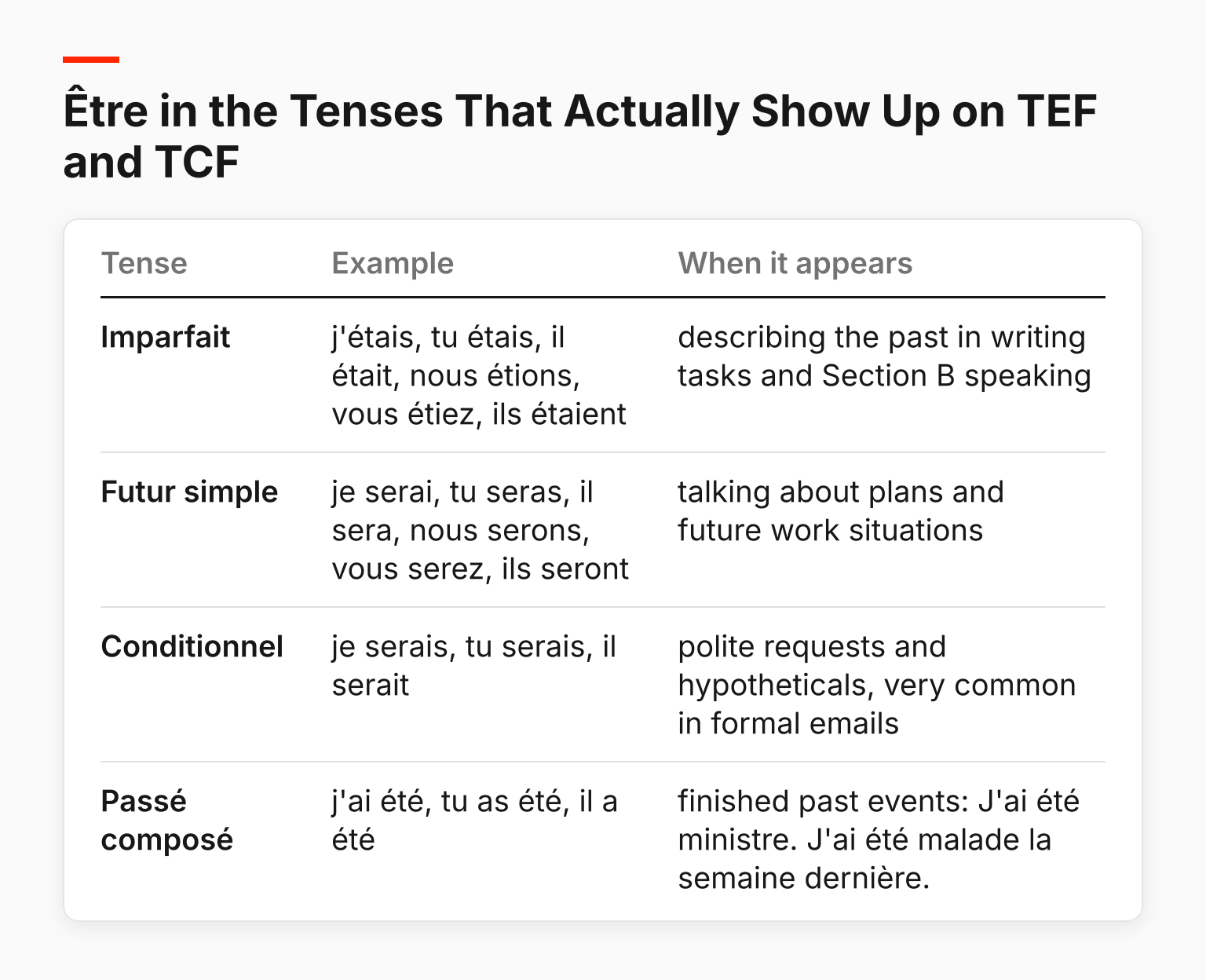
| Tense | Example | When it appears |
|---|---|---|
| Imparfait | j'étais, tu étais, il était, nous étions, vous étiez, ils étaient | describing the past in writing tasks and Section B speaking |
| Futur simple | je serai, tu seras, il sera, nous serons, vous serez, ils seront | talking about plans and future work situations |
| Conditionnel | je serais, tu serais, il serait | polite requests and hypotheticals, very common in formal emails |
| Passé composé | j'ai été, tu as été, il a été | finished past events: J'ai été ministre. J'ai été malade la semaine dernière. |
For completeness: the subjunctive starts with que je sois, and the imperative is sois, soyons, soyez. You will mostly meet que je sois-style forms in subordinate clauses in reading texts.
Serai vs serais: one letter, one graded error
Je serai is the futur simple: Je serai à Toronto en mars (I will be in Toronto in March). Je serais is the conditionnel: Je serais heureux de vous rencontrer (I would be happy to meet you). They sound identical out loud, so the listening section never tests the difference, but the writing section does. In a formal email, mixing them changes your meaning: a promise becomes a maybe. Before you submit, check every ser- form and ask: is this a plan (serai) or a politeness or hypothesis (serais)?
Pronunciation Traps in the Listening Section
The listening sections are full of être-sounding words, because French is packed with homophones. Train your ear on these pairs:
- es, est, et: Tu es prêt, Il est prêt, and Jean et Marie all sound the same in isolation. Context tells you which one you heard, so listen to the whole sentence, not the word.
- suis: je suis can mean "I am" (Je suis fatigué, I am tired) or "I follow" (je suis le train, I follow the train), and la suite (the rest, the sequel) sounds exactly the same. Same sound, three possible jobs, so let the sentence decide which one you heard.
- était vs sound-alikes: Il était là (he was there) versus Il hésitait (he hesitated). In a fast recording, the h is silent and the endings blur. Train with numbers and dates too, because times and years sit right next to these verbs: en 2019, j'étais étudiant. The French numbers guide for TEF Canada listening covers the number-recognition side of the same problem.
If you want audio models for the verb itself, French Today's être page includes recordings of each form, which is useful for shadowing practice.
Why Être Matters as an Auxiliary
Here is where être stops being one verb and starts powering half your grammar. French has two auxiliary (helper) verbs for compound tenses: avoir and être. Most verbs use avoir. A specific group uses être in the passé composé, and that group comes with a rule the exam grades directly.
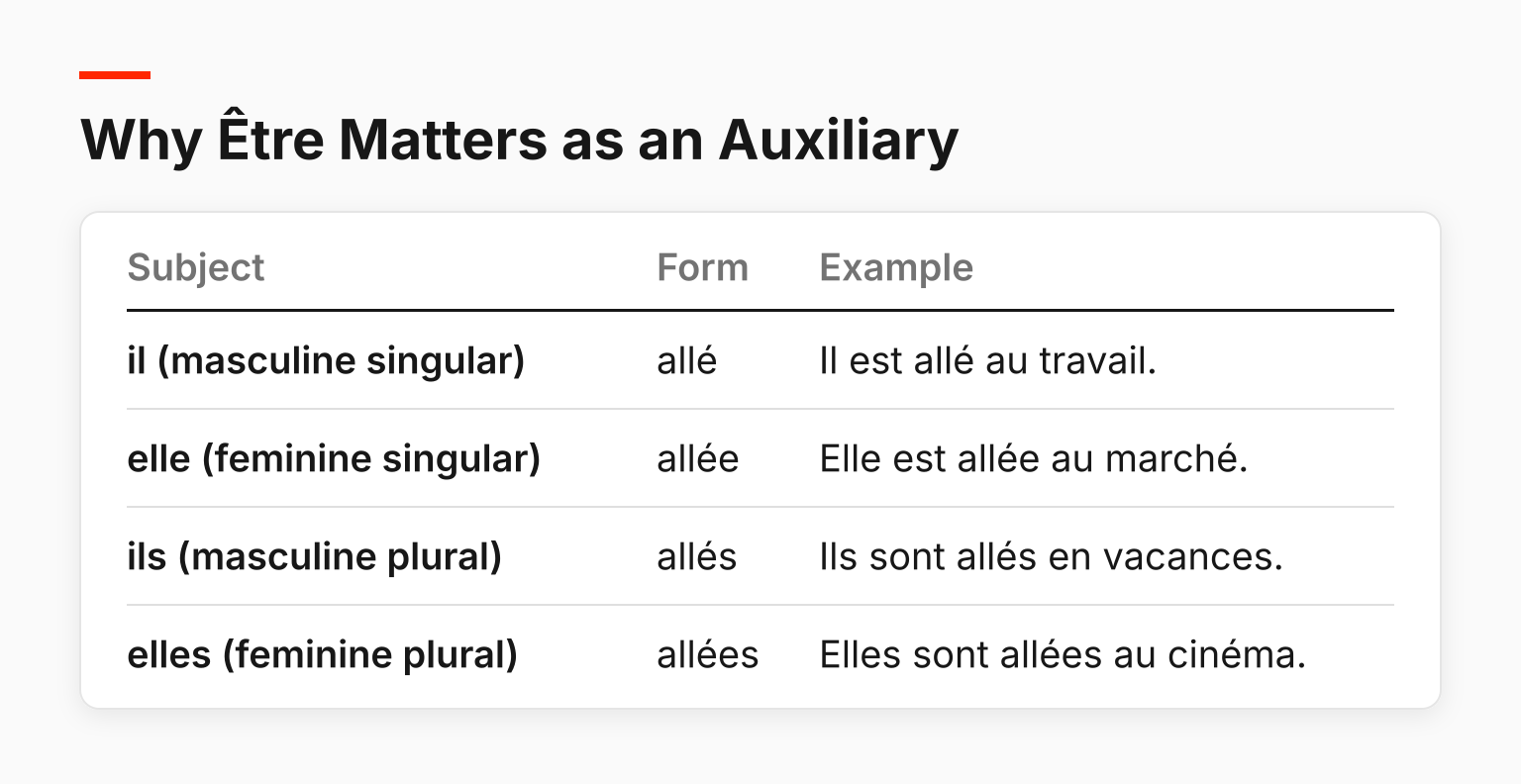
The agreement rule
When a verb takes être in the passé composé, the past participle agrees with the subject in gender and number, exactly like an adjective:
| Subject | Form | Example |
|---|---|---|
| il (masculine singular) | allé | Il est allé au travail. |
| elle (feminine singular) | allée | Elle est allée au marché. |
| ils (masculine plural) | allés | Ils sont allés en vacances. |
| elles (feminine plural) | allées | Elles sont allées au cinéma. |
Notice something that trips up listeners: in speech, allée, allés, and allées often sound identical to allé. The agreement is invisible when you speak but fully visible when you write, which is why the writing section is where candidates lose the points. Always check the -e and -s endings on être-auxiliary participles before you submit.
Which Verbs Take Être in the Passé Composé
The list is usually taught with the acronym DR MRS VANDERTRAMP, but sources disagree on the count (some list 14 verbs, some 16 or 17, depending on whether they include passer and a few others). Rather than memorize an acronym, group the verbs by what they mean. Every one of them is a movement or a change of state:
- Movement verbs: aller, venir, arriver, partir, entrer, sortir, monter, descendre, retourner, revenir, tomber.
- Birth, death, and becoming: naître, mourir, devenir.
- Staying: rester, and rester-adjacent rentrer (going back home).
Elle est née à Lyon. Il est mort en 2020. Nous sommes arrivés tard. Je suis resté à la maison. If the verb describes someone moving or changing state, and there is no direct object, expect être.
The Pivot Verbs That Switch to Avoir
Seven verbs on that list can also take a direct object, and when they do, they switch to avoir, and the meaning changes:
| With être (no direct object) | With avoir (direct object) |
|---|---|
| Il est monté au troisième étage. (He went up to the third floor.) | Il a monté les valises. (He took the suitcases up.) |
| Elle est descendue du bus. (She got off the bus.) | Elle a descendu la poubelle. (She took the trash down.) |
| Je suis sorti hier soir. (I went out last night.) | J'ai sorti la voiture. (I took the car out.) |
| Nous sommes entrés dans la salle. (We entered the room.) | J'ai entré les données. (I entered the data.) |
| Ils sont rentrés à minuit. (They got home at midnight.) | Ils ont rentré les chaises. (They brought the chairs in.) |
| Elle est retournée à Paris. (She went back to Paris.) | Elle a retourné la crêpe. (She flipped the crêpe.) |
| Je suis passé chez lui. (I stopped by his place.) | J'ai passé deux ans à Lyon. (I spent two years in Lyon.) |
The test is mechanical: look right after the verb. If something is being acted on (les valises, la voiture, deux ans), use avoir. If a prepositional phrase follows instead (au troisième étage, chez lui), there is no direct object, so être stays.
Pronominal Verbs Always Take Être
Any verb with a reflexive pronoun (me, te, se, nous, vous) uses être in the passé composé: je me suis préparé, elle s'est levée tôt, nous nous sommes inscrits. This is directly relevant to exam tasks about daily routines, moving house, and preparation, which are staple TEF and TCF writing and speaking topics. The agreement rules here have one extra layer (agreement with a preceding direct object, as in the elle s'est lavée vs elle s'est lavé les mains distinction), but for most exam sentences, agreeing with the subject is the safe default.
A Simple Être vs Avoir Decision Rule
Under exam time pressure, run these questions in order:
- Is the verb pronominal (has me, te, se)? Use être.
- Does it have a direct object (something the action is done to, with no preposition)? Use avoir.
- Is it a movement or change-of-state verb with no direct object (aller, venir, partir, arriver, sortir, naître, mourir, rester, and friends)? Use être, and add agreement.
- Anything else? Use avoir.
Ninety-nine percent of verbs live in that last bucket, which is why the recommended habit is to ask "why not avoir?" first, and only switch to être when you can name the reason.
Common Exam-Costly Mistakes
These are the errors that show up again and again in graded TEF/TCF writing and speaking:
- Missing agreement. Writing elle est allé instead of elle est allée. In speaking it costs nothing; in writing it costs points every time.
- Auxiliary swaps on pivot verbs. Writing je suis sorti la voiture instead of j'ai sorti la voiture. The direct object test catches this one.
- Je suis été. This form does not exist. Être itself takes avoir: j'ai été fatigué, j'ai été à Montréal (in casual Canadian French), j'ai été ministre.
- il est vs c'est. Use il est for describing a specific person or thing with an adjective (Il est grand, Elle est Canadienne) and c'est for identifying or presenting something (C'est mon frère, C'est difficile). Mixing them is a small error, but a repeated one.
- Using être where avoir belongs in writing. In formal emails, candidates sometimes over-correct and write je suis reçu votre courriel instead of j'ai reçu votre courriel. Recevoir takes avoir.
The agreement and auxiliary rules above feed directly into the structures in the TEF Canada writing cheat sheet, which shows where these forms belong in a scored response.
How These Forms Show Up on Exam Day
A quick map from grammar to task, so you know what to look for:
- Speaking, Section A/B: past-event questions almost demand être-auxiliary passé composé. Pourquoi êtes-vous venu au Canada? Je suis arrivé en 2023 et je me suis installé à Ottawa. The TEF Canada speaking cheat sheet gives you the full framework around these forms.
- Writing tasks: the classic formal email about a move, a new job, or a complaint leans on imparfait (j'étais), conditionnel (je serais reconnaissant), and passé composé with être (je me suis installé, nous sommes arrivés).
- Listening: être forms are anchors. Il était une fois, elle est partie, ils sont restés tell you who did what, and they are the skeleton of every transcript.
Quick Self-Check
Choose être or avoir, and add agreement where needed. Answers below.
- Hier, elle (aller) ___ au centre d'examen.
- Ils (sortir) ___ les poubelles ce matin.
- Je me (préparer) ___ pendant six mois.
- Nous (être) ___ très occupés la semaine dernière.
- Tu (passer) ___ l'examen en mars? (meaning: take the exam)
Answers: 1. est allée (movement, no object, feminine agreement). 2. ont sorti (direct object, so avoir). 3. me suis préparé(e) (pronominal, so être). 4. avons été (être takes avoir). 5. as passé (passer with the exam as direct object, so avoir).
If you missed more than one, drill the decision rule until it is automatic, then work it into your routine using the study strategies in the self-study guide for TEF Canada, which shows how to schedule grammar drills alongside skill practice.
Practice These Forms Under Real Conditions
Knowing the chart and producing the right form in 30 seconds are different skills. On CanadaFrenchPath you can start free practice with 1,000 credits and apply être forms, auxiliary choices, and agreement inside full TEF and TCF-style mock exams, with AI grading that flags exactly these mistakes in your writing and speaking.