
Summary of the Article
- à (au, aux): direction, location, time, and who receives something. Je téléphone au directeur.
- de (du, des): where something comes from, ownership, material, and fixed verb pairs like finir de. Je viens du Canada.
- pour: why you do something, who it is for, and planned future time. Je pars pour deux semaines.
- The most penalized errors: J'ai étudié pour deux ans (should be depuis or pendant), à France (should be en France), and à côté le parc (should be à côté du parc).
English speakers often translate "for" and "to" word for word, and that habit costs marks in TEF Canada and TCF Canada writing, where grammar accuracy is a scored criterion. This article gives you the rules, the fixed verb pairs, and a short self-check so you can catch these errors before exam day.
Why translation fails: the 10-second version
A preposition does not carry meaning on its own. It marks a relationship between two words, as the Canadian government's language portal explains: the same French preposition can express several relationships, and one relationship can be expressed by several prepositions. They are not interchangeable.
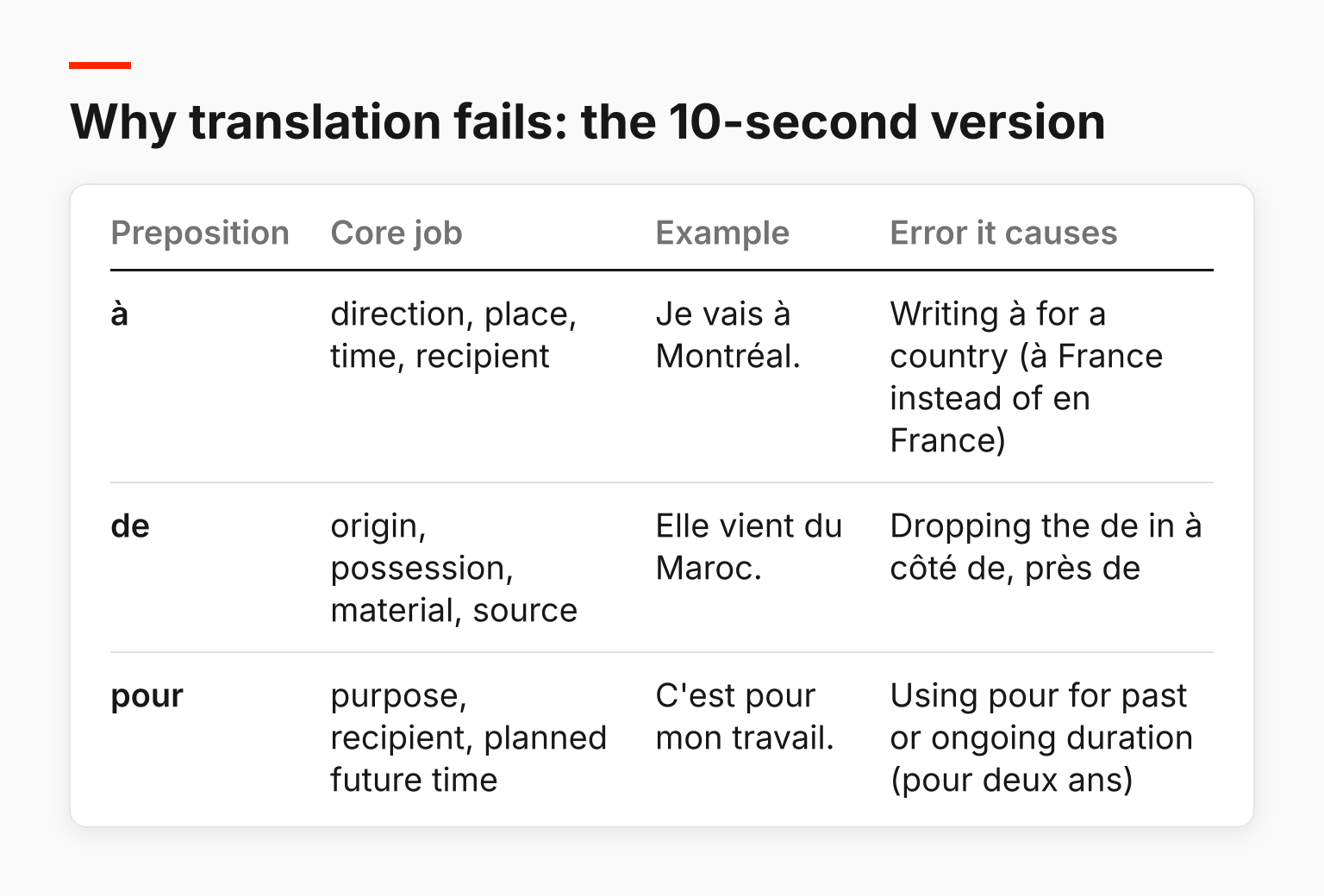
So stop asking "how do I say 'for' in French?" and start asking "what is this word doing in my sentence?" Here is the quick-answer table.
| Preposition | Core job | Example | Error it causes |
|---|---|---|---|
| à | direction, place, time, recipient | Je vais à Montréal. | Writing à for a country (à France instead of en France) |
| de | origin, possession, material, source | Elle vient du Maroc. | Dropping the de in à côté de, près de |
| pour | purpose, recipient, planned future time | C'est pour mon travail. | Using pour for past or ongoing duration (pour deux ans) |
À: pointing at a place, time, or person
À marks a point. You arrive at a place, at a time, or you give something to a person.
- Direction and place: Je vais à la bibliothèque. Il habite à Ottawa.
- Time: Le rendez-vous est à 14 h. Je me lève à six heures.
- Recipient: Je téléphone à ma sœur. Elle a écrit à son professeur.
The contractions: au and aux
À contracts with the definite articles le and les. This is a rule, not a style choice, and skipping it is one of the fastest ways to signal a non-native writer.
- à + le = au: Je vais au cinéma (never à le cinéma).
- à + les = aux: Je parle aux enfants (never à les enfants).
- à + la and à + l' do not contract: à la plage, à l'hôtel.
Verbs that take à
Some verbs are permanently glued to à. Learn them as whole units:
- commencer à faire quelque chose (Je commence à étudier le français.)
- téléphoner à quelqu'un (Je téléphone au service d'immigration.)
- réfléchir à (Je réfléchis à ta proposition.)
- jouer à (a sport or game) versus jouer de (an instrument)
De: where something comes from and who owns it
De is the mirror of à. Where à points to a point, de moves away from one.
- Origin: Elle vient de Paris. Je viens du Canada.
- Possession: C'est le livre de mon frère. La couleur du ciel.
- Material: une table en bois, but also une boîte de carton.
- Source of an action: Il est tombé de l'escalier.
The contractions: du and des
- de + le = du: Je viens du Japon (never de le Japon).
- de + les = des: Il parle des États-Unis (never de les États-Unis).
- de + la and de + l' do not contract: de France, de l'Ontario.
Verbs that take de
Another fixed set:
- finir de faire quelque chose (J'ai fini de rédiger ma lettre.)
- parler de quelque chose (Nous parlons du nouvel emploi.)
- avoir besoin de (J'ai besoin de plus de temps.)
- venir de (the origin verb: Elle vient des Philippines.)
Don't drop the de in compound prepositions
Compound prepositions end in de, and learners drop it constantly: à côté de, en face de, près de, loin de, à cause de.
- Correct: J'habite à côté du parc.
- Wrong: à côté le parc or even à côté de le parc.
Note how the de then contracts: à côté de + le parc = à côté du parc. Two rules in one sentence.
Pour: purpose, recipient, and planned time
Pour answers "why?" or "for whom?" It points forward.
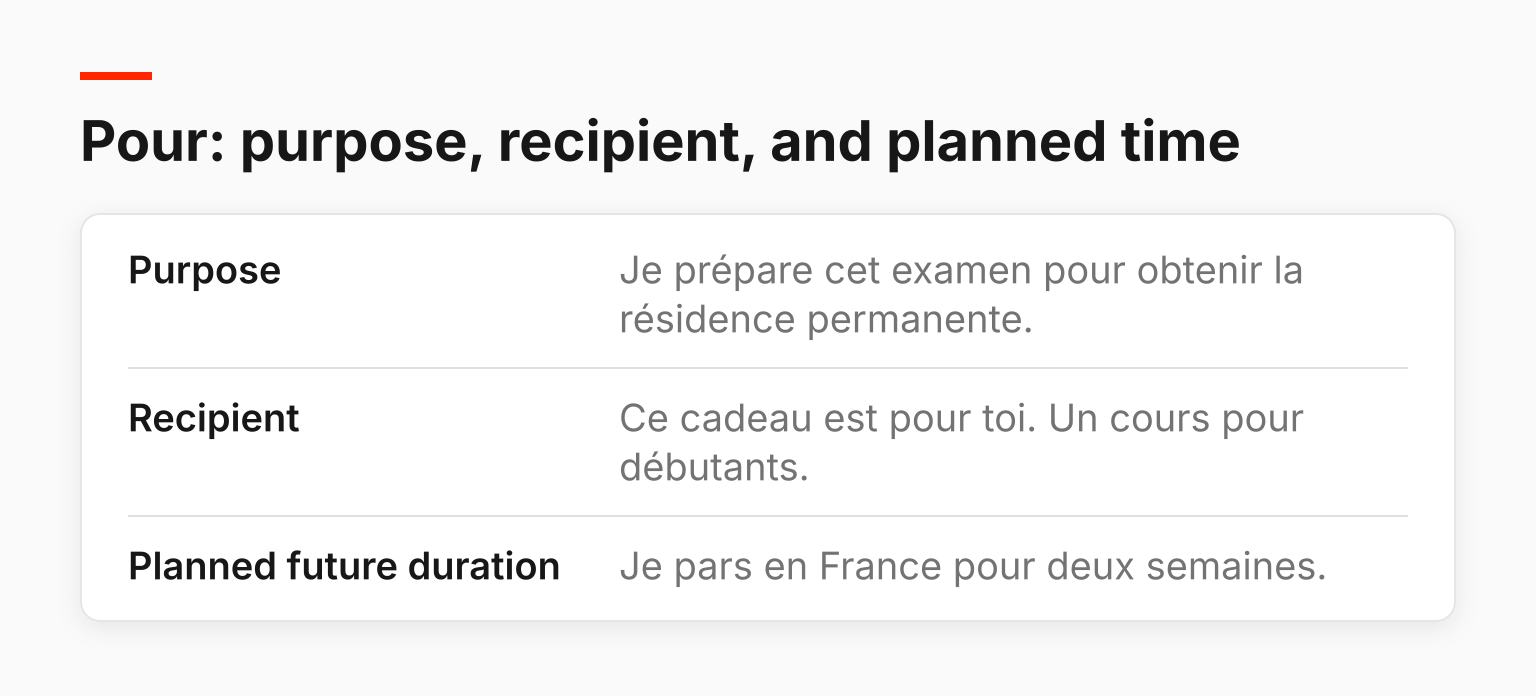
- Purpose: Je prépare cet examen pour obtenir la résidence permanente.
- Recipient: Ce cadeau est pour toi. Un cours pour débutants.
- Planned future duration: Je pars en France pour deux semaines.
For formal writing, you can also use afin de (in order to), which is slightly stronger and more written-register. The official Canadian style guide notes that afin de implies a deliberate goal, and pour can always replace it, but not the other way around. For exam purposes, pour is safe almost everywhere.
The big trap: pour vs depuis vs pendant
This is the single most common preposition error in TEF/TCF writing. English uses "for" for all three ideas; French splits them:
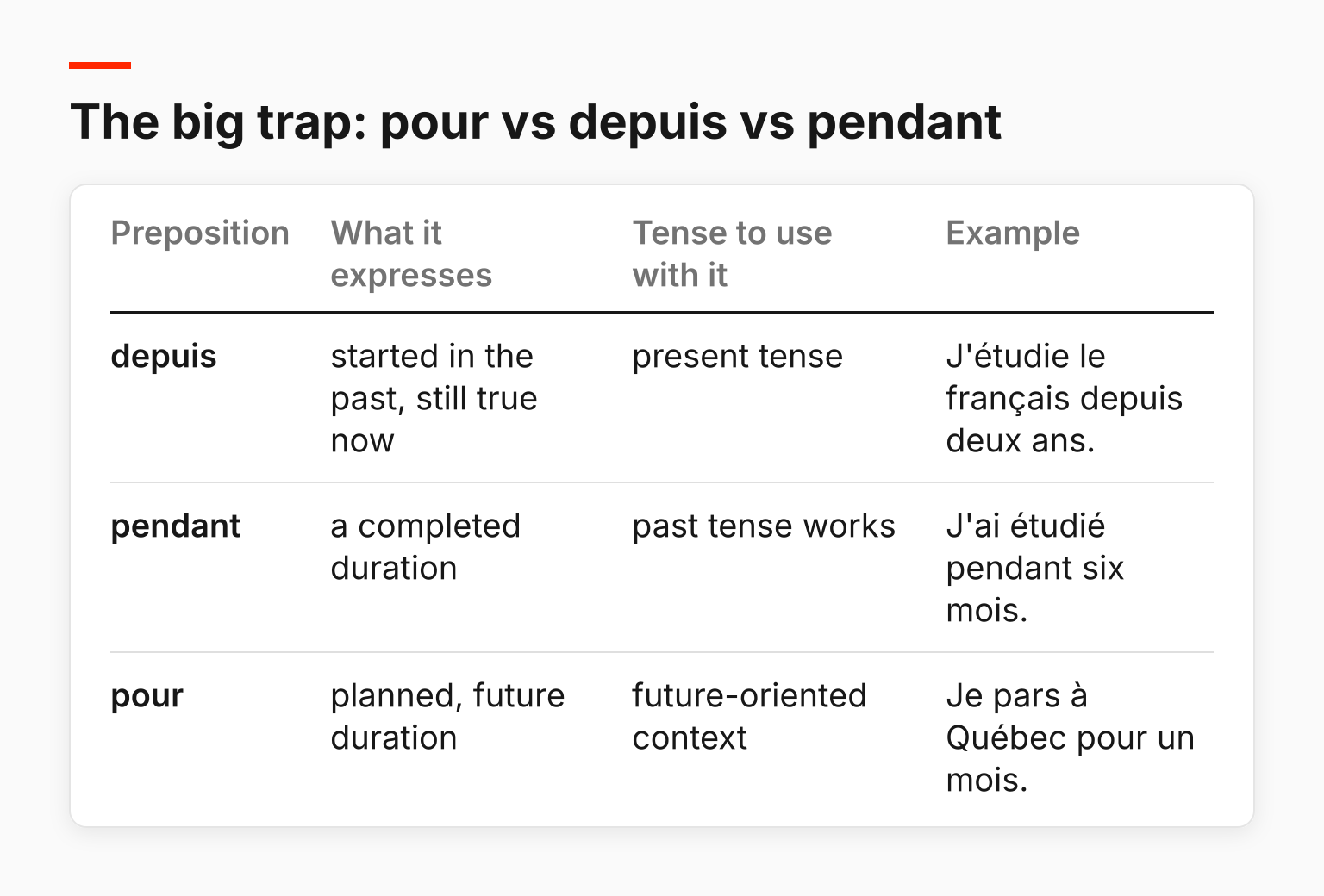
| Preposition | What it expresses | Tense to use with it | Example |
|---|---|---|---|
| depuis | started in the past, still true now | present tense | J'étudie le français depuis deux ans. |
| pendant | a completed duration | past tense works | J'ai étudié pendant six mois. |
| pour | planned, future duration | future-oriented context | Je pars à Québec pour un mois. |
The classic mistake: J'ai étudié pour deux ans. If the studying is ongoing, use depuis with the present tense: J'étudie le français depuis deux ans. If it is finished, use pendant: J'ai étudié pendant deux ans avant l'examen. Save pour for time you plan in the future.
The mistakes exam graders penalize most
Both the TEF Canada and TCF Canada writing sections score grammatical accuracy as its own criterion, so repeated preposition errors pull your band below B2 (NCLC 7). These are the errors that cluster around à, de, and pour:
- Pour for duration. J'ai travaillé pour trois ans. Use depuis (still true) or pendant (finished).
- À with countries. Je vais à France. Use en France, au Canada, aux États-Unis. Cities take à: à Toronto.
- Dropped de in compounds. À côté le parc, près l'école. The de is mandatory: à côté du parc, près de l'école.
- Missing contractions. Je vais à le cinéma, la couleur de le ciel. Always au, du, aux, des.
- Wrong fixed verb pair. J'ai commencé de travailler. It's commencer à travailler, while finir takes de.
- Pour where pour doesn't fit at all. J'attends pour le bus. French says attendre le bus: the verb takes a direct object with no preposition.
None of these are subtle. They are exactly the kind of errors a B2 candidate is expected to have eliminated, which is why graders notice them immediately.
Fixed verb-preposition pairs to memorize
Exam writing prompts (describing your city, explaining your study plan, comparing options) reliably call on these pairs:
| Verb | Preposition | Example |
|---|---|---|
| commencer | à | Je commence à préparer mon dossier. |
| finir | de | J'ai fini de répondre à la question. |
| décider de | de | J'ai décidé de passer le TEF. |
| essayer de | de | J'essaie de progresser en écriture. |
| parler | de | Nous parlons de l'immigration. |
| téléphoner | à | Je téléphone à l'école de langues. |
| avoir besoin | de | J'ai besoin de pratiquer chaque jour. |
| réussir | à | Elle a réussi à obtenir NCLC 7. |
If a verb on this list appears in your writing task, write the pair together as one unit. The site's government preposition tool (in French) lets you look up which preposition any verb, adjective, or adverb takes, which is useful for pairs not listed here.
Mini self-check: fill in à, de, or pour
Cover the answers and complete each sentence. Some take a contracted form (au, du, aux, des, en).
- Je vais ______ Canada le mois prochain.
- Elle vient ______ Lyon depuis peu.
- Ce dictionnaire est ______ mon professeur.
- J'étudie le français ______ deux ans. (and I still do)
- Il habite à côté ______ la gare.
- Nous avons fini ______ rédiger la lettre.
- Je pars à Toronto ______ trois jours.
- J'ai téléphoné ______ agence de voyage.
Answers: 1) au (Canada is masculine: au, never en Canada). 2) de (or: de la ville de Lyon). 3) pour (recipient). 4) depuis (present tense, ongoing). 5) de, then contracted: à côté de la gare. 6) de (finir de). 7) pour (planned future duration). 8) à, contracted: à l'agence de voyage.
If you missed two or more, reread the à and pour sections. The duration trap (question 4 versus 7) is worth drilling until it is automatic.
Where to practice this before your exam
Rules only become reflexes when you use them under time pressure. When you write your TEF/TCF practice tasks, add a two-minute review pass that hunts only for these errors: contractions (au, du, aux, des), the de in compound prepositions, and every sentence with a duration, checking depuis versus pendant versus pour. Then put the rules to work in a full writing task using the TEF Canada Writing Cheat Sheet, and keep building the grammar around it with avoir conjugation and être conjugation, the two verbs behind most of the tense choices in these sentences.
When you want that error list checked automatically, you can start free practice with 1,000 credits on CanadaFrenchPath: you write exam-style tasks across the four skills, and the AI grading flags exactly these kinds of preposition and grammar slips so you can fix them before test day.